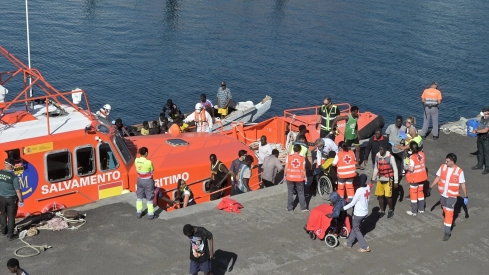
El Hierro received this Tuesday 2,100 immigrants aboard 15 cayucos, on a day that also leaves one deceased and the birth of a four-day-old girl in the middle of the Atlantic crossing, according to data compiled by EFE from the emergency services of La Restinga.
This is the highest figure for a single day since records began in Spain, on a migratory route that the Canary Islands are enduring this month with particularly intense pressure, to the point that records last barely a few days. The previous record had been set on November 14, with 1,580 people arriving in El Hierro, Gran Canaria and Tenerife.
Before that episode, the maximum dated back to 2020, when 1,461 people were rescued on November 7, in the midst of the cayuco crisis, a year that closed with 31,678 rescued.
Eight nationalities among the rescued
Among the occupants of the boats were people from Gambia, Senegal, Guinea Conakry, Guinea Bissau, Burkina Faso, Mauritania and Mali, as well as a refugee from Yemen. The data also reflect the presence of women and minors in several of the cayucos, with cases of special vulnerability, such as a baby of a few months and the newborn delivered on the high seas.
In total, emergency services count at least 203 women and 127 minors, including a baby of about four months and a girl born during the crossing of one of the cayucos rescued 70 kilometers from El Hierro by the Guardamar Calíope. According to the same data, among the rescued are also 177 women and 107 minors.
The first arrivals, at dawn
The first cayuco to arrive in El Hierro this November 24 entered La Restinga at 2:45 AM, escorted by the Salvamar Navia, with 217 occupants who had been located hours earlier by the Guardamar Calíope 102 kilometers from the Canary Islands. In that group traveled 13 women and 18 minors, and its occupants were from Gambia and Senegal, in addition to the refugee from Yemen, who had left Gambia seven days earlier.
At 3:00 AM, the Salvamar Acux escorted a second cayuco to the pier with 190 people, who had remained seven days in the Atlantic after departing from Casamance (Senegal). Aboard were citizens from Gambia, Senegal and Guinea Bissau, including 20 women and 8 minors.
The third rescue occurred at 4:29 AM, when the Salvamar Diphda rescued another boat with 217 people, including 21 women and 12 minors, from Gambia, Senegal and Guinea Bissau, after a seven-day journey from Gambia.
Around 5:50 AM, the Salvamar Navia again accompanied a fourth cayuco to La Restinga with 171 occupants, including 23 women and 18 minors, who had arrived from Dakar six days earlier. One of the occupants was transferred to the Hospital de Valverde with a case of severe hypothermia.
At 8:45 AM, a fifth cayuco entered the pier, also with the Salvamar Navia, with 93 migrants, all Senegalese, including 5 women and 6 minors. According to their testimony, they had departed from Guéréo (Senegal) six days earlier.
A second wave in the afternoon
Arrivals reactivated in the early afternoon, when the Salvamar Ácrux assisted two other cayucos, at 12:55 PM and 1:10 PM, with a total of 186 occupants.
One of them had left Gambia seven days earlier and was transporting 140 people from Gambia, Senegal, Guinea Bissau and Guinea Conakry, including 37 women, 9 minors and a two-month-old baby. The other came from Dakar, after five days of navigation, with 46 occupants, of whom 9 were minors.
While these boats were being attended to at the pier, an eighth cayuco arrived on its own with 208 occupants, after seven days of crossing from Bargny (Senegal). On board were citizens from Gambia, Senegal, Guinea Conakry, Mauritania, Burkina Faso and Mali, including 36 women and 20 minors.
Around 5:30 PM, the ninth cayuco of the day arrived, with the Salvamar Mízar, also from Dakar, from where it had set sail six days earlier. It was transporting 119 people from Gambia, Senegal, Guinea Conakry and Guinea Bissau, including 8 women and one child.
The same rescue vessel escorted a tenth cayuco an hour later with 157 people, of whom 133 were men, 11 women and 13 minors. It had departed seven days earlier from Brufut, in Gambia, and its occupants were from that country, as well as from Senegal, Guinea Conakry and Guinea Bissau.
The eleventh cayuco carried 53 people, including 3 women and 2 minors, who had left Tanjeh, in Gambia, seven days ago.
The last rescue, with one deceased on board
At 8:20 PM, the Salvamar Mízar escorted another cayuco to the pier with 126 people from Senegal, Gambia and Guinea Conakry, coming from Senegal after seven days of travel, and in which there were 8 women.
Afterwards, the same vessel left again to pick up 172 people rescued by the Guardamar Mízar 70 kilometers from the island, in two cayucos from Gambia. Among them were nationals of Gambia, Senegal, Mali and Guinea Conakry, with 18 women and 10 minors, one of them the newborn.
Around 10:00 PM, the Salvamar Diphda arrived at the pier with the 191 occupants of the fifteenth cayuco of the day, several in poor health and one of them already deceased.
Contact