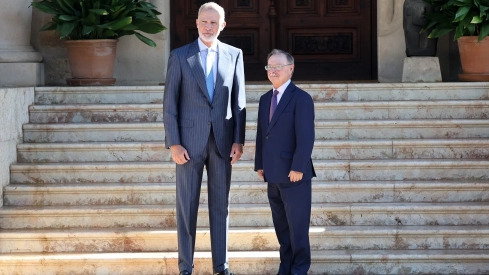
King Felipe VI has once again placed Ceuta within the external border of the European Union this Tuesday and has called for greater involvement of the Twenty-Seven in its protection. "Spaniards and Finns are the external border of the EU," he affirmed during the gala dinner offered by the President of Finland, Alexander Stubb, within the framework of his State visit to the country. The message comes a week before Felipe VI and Queen Letizia travel to Ceuta, next October 13, and two and a half months after the migratory crisis that the city experienced at the end of July.
The visit, agreed upon between the Royal Household and the Government, will be the first of the current monarchs to the two autonomous cities and will take place without Pedro Sánchez. "Our border is one and the same for all citizens of the Union," the monarch defended. Felipe VI thus insisted on an idea he had already conveyed last week during Emmanuel Macron's visit to Spain: countries that bear greater pressure from being on the European external border should not face that responsibility alone.
"Threats, wherever they come from and whatever their intention, are threats to all Member States," he pointed out. The King demanded that the protection of this common border be carried out through a "solidary and effective exercise" and warned that not only the security of each country, but also the future of the European project, depends on this "shared effort."
Ceuta, one week before the Kings' visit
The speech acquires special relevance due to the moment in which it occurs. The visit of Felipe VI and Letizia to Ceuta is scheduled for October 13, while the following day they will travel to Melilla. The trip takes place after the migratory crisis at the end of July and in the midst of discussion about the institutional response to what happened at the border. The Royal Household and the Government have defended that the visit aims to convey the presence and commitment of the State to the two cities. Felipe VI has followed the situation in Ceuta since the beginning of the crisis and already held a meeting with the city's president, Juan Jesús Vivas, during the summer.
In his speech before Macron, the monarch had already called for greater European cooperation and had defended that countries that bear greater pressure from being on the external border "cannot face alone a responsibility that belongs to everyone." Then he described what happened in Ceuta during the summer as "unacceptable" and called for greater European effectiveness and solidarity in the protection of the external border. Now, from Finland, Felipe VI has once again used the same argument, although in a broader context of European security. The issue of Ceuta is thus linked to the debate on how the EU protects its external borders and how it distributes that responsibility among Member States.
The visit comes at a particularly sensitive time
The Kings' trip will also take place while issues related to the care of migrants who arrived in Ceuta during the July crisis remain open. The situation of minors and reception conditions continue to be part of the public debate in the city. In fact, the Minister of Youth and Children, Sira Rego, recently visited Ceuta, where she met with city officials and with minors who remain in a vulnerable situation.
The Kings' visit has been positively received by different sectors of the city, although it has also been pointed out that it comes months after the crisis. The president of Ceuta, Juan Jesús Vivas, has defended that the presence of Felipe VI is a show of support for the people of Ceuta after what happened in July. It will also be the first official visit of Felipe VI and Letizia to Ceuta and Melilla since their accession to the throne. The last trip of the Kings to the two cities dates back to 2007, when Juan Carlos I and Sofía still reigned, in a visit that then caused a diplomatic crisis with Morocco.
From the Ceuta crisis to the European debate
Beyond the institutional nature of the trip, Felipe VI's message once again places Ceuta in a debate that transcends Spanish borders. The King maintains that the condition of an external EU border also implies a shared responsibility among Member States.
During his visit to Finland, the monarch linked this issue to the need to strengthen European security and recalled the participation of the Spanish Armed Forces in different scenarios on the continent. He also advocated for a Europe with greater capacity for action and cooperation in defense matters. But the focus of his message has been on Ceuta: a city located on the external border of the Union that faced one of the biggest migratory crises in its recent history this summer. A week before his visit, Felipe VI once again demands that this border not be understood solely as a Spanish responsibility, but as an issue that affects the entire European Union.
