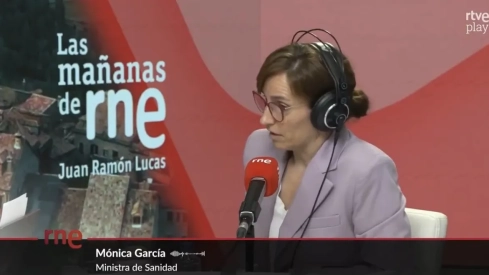
The Minister of Health, Mónica García, has called for caution regarding the report that, according to information published this Wednesday, would attribute a role to Moroccan gendarmes in the massive entry of migrants into Ceuta. In statements to RNE, García stressed that it is a document whose credibility still needs to be investigated and has supported Fernando Grande-Marlaska's decision to ask for explanations about its content. "The credibility will have to be investigated," she said, insisting that any assessment must be made conditionally and pending official knowledge of the report. "We will have to ask for explanations about that report. If it turns out to be true, conditionally, I believe it is serious [...] We have always said that it is undeniable that there is a responsibility, by action or omission, on the part of Morocco."
ENTREVISTA | @Monica_Garcia_G, ministra de @sanidadgob: "Habrá que pedir explicaciones sobre ese informe. En caso de ser verdad, creo que es grave [...] Nosotros siempre hemos dicho que es indudable que hay una responsabilidad, por acción u omisión, de Marruecos" pic.twitter.com/rDOGy3h1OA
— Las Mañanas de RNE (@LasMananas_rne) September 2, 2026
The minister warned, however, that the consequences would be significant if direct involvement by Morocco were finally confirmed. "If it turns out to be true, I believe it is serious," said García, who considers that such eventual involvement would imply Rabat's participation in the events. In that scenario, she argued that the Spanish Government would have the obligation to demand explanations and responsibilities, not only because it is an issue that affects national sovereignty, but also because of Ceuta's status as an external border of the European Union.
"I believe it is imperative," García responded when asked about the possibility of Spain adopting diplomatic or political measures if Morocco's direct involvement were confirmed. The minister also called for greater involvement from Brussels in a situation she considers particularly sensitive within community territory. In her opinion, there is a certain "lack of solidarity" from Europe regarding a particularly complex border, and the management of migratory flows must be assumed as a shared responsibility by the entire European Union.
ENTREVISTA | @Monica_Garcia_G, ministra de @sanidadgob, sobre la postura de Bruselas frente a la crisis en Ceuta: "¿Se podría hablar de cierta falta de solidaridad? Sí [...] Creo que es competencia de toda la UE hacerse cargo de estos flujos migratorios"
— Las Mañanas de RNE (@LasMananas_rne) September 2, 2026
▶️https://t.co/HABQgJI4Va pic.twitter.com/c72r4i6Lgc
García also took advantage of her intervention to criticize the Spanish right, especially the Popular Party, which she accused of prioritizing the government's desgaste over the defense of national interests. The minister questioned the opposition's focus on criticizing the Executive while, in her opinion, there are elements that could point to an attempt to destabilize Spain. García thus defended that, if the report ends up confirming a direct intervention by Morocco, the response must be in the realm of defending the sovereignty and interests of Spain and the European Union itself.
Mónica García has also defended the response of healthcare services to the massive arrival of migrants in Ceuta and has denied that the situation has led to a collapse of public healthcare. In statements to RNE, García acknowledged that the autonomous city has experienced a situation of "healthcare tension, without a doubt," but highlighted the work carried out by healthcare officials and professionals to prevent that pressure from ending up affecting the local population. "We have deployed mechanisms and resources to prevent that situation from becoming a collapse," she explained.
The minister assured that "no Ceuta resident has seen their healthcare diminished" and that the Ministry's data show similar attendance by the local population in both emergencies and healthcare centers. To absorb the additional demand, healthcare circuits have been diversified, and some centers have been primarily oriented towards caring for migrant people, whose pathologies are, according to García, fundamentally minor, such as wounds and other ailments. The head of Health thus highlighted the work of professionals who work "at the bedside, at the emergency room, at the health centers" during the crisis.
ENTREVISTA | @Monica_Garcia_G, ministra de @sanidadgob: "En Ceuta hemos tenido una situación de tensión asistencial, sin lugar a dudas [...] Hemos diversificado los circuitos para que las personas ceutíes no vean mermada su calidad asistencial"
— Las Mañanas de RNE (@LasMananas_rne) September 2, 2026
▶️https://t.co/HABQgJI4Va pic.twitter.com/Ou0eql8UGK
García has also lashed out against those who, in her opinion, are using the situation to fuel xenophobic discourses. The minister has defended that the response must stem from the protection of human rights and the care of people fleeing "absolutely desperate" situations, in contrast to what she considers a right-wing strategy to "incite the Government of Spain". In this regard, she criticized the words of Vox deputy José María Figaredo, who spoke of "hunting migrants", considering that such messages can act as a signal to encourage "violent demonstrations against those migrants".
The minister has also been asked about the police report that, according to published information, would attribute to Moroccan gendarmes the guidance of the massive entry of migrants into Ceuta. García has insisted that the credibility and content of the document must first be verified and has supported the Minister of the Interior, Fernando Grande-Marlaska, in demanding explanations from the Police leadership. "To talk about it now is to make conjectures," she defended. However, she warned that, if direct participation by Morocco were confirmed, it would be serious and Spain would have to demand explanations and accountability from Rabat. In her opinion, it would also be an issue affecting a European border and would require a response also from the European Union, which she reproached for a certain lack of solidarity at one of the "most sensitive" and complex borders of the community territory.