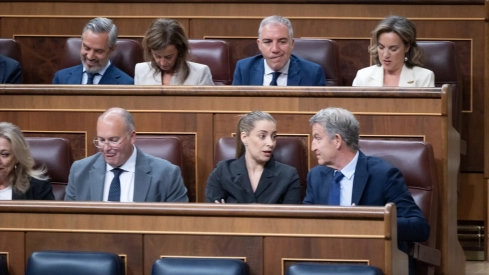
The Popular Party of Alberto Núñez Feijóo has been pointing since the beginning of the Ceuta crisis to Morocco as involved in the massive entry of people through its border with Spanish territory. The leader of the main opposition party even issued a statement in which they held them responsible for the crisis "by action or omission." In this regard, the neighboring country has stated: “The statements made by Spanish political actors show that they do not measure value.”
This was expressed by Nasser Bourita, Moroccan Minister of Foreign Affairs, after meeting with his Spanish counterpart, José Manuel Albares, in New York. The Moroccan minister did not directly appeal to the PP, but he criticized the statements of “Spanish political actors” and stated that "they do not know today's Morocco and have no knowledge of the migratory issue and its management."
Along these lines, Bourita continued to defend that the neighborhood relationship between Morocco and Spain, also in migratory matters, should not be addressed through "escalation, demands, and unfounded accusations." In this context, he regretted that a debate about Ceuta continues in Spain, in which "prominent political actors who continue to pour gratuitous demands and accusations into the controversy and insult the value of this association" participate.
The Moroccan minister has placed the framework of bilateral relations in the joint declaration signed in April 2022, after the meeting held between Pedro Sánchez and King Mohammed VI. That meeting allowed to close the diplomatic crisis opened between both countries after Spain hosted the leader of the Polisario Front, Brahim Ghali, who had been transferred to the country to receive medical attention after contracting COVID-19.
According to him, this agreement continues to be the basis on which the relationship between Morocco and Spain is articulated.
The meeting between Albares and his Moroccan counterpart
The Moroccan Minister of Foreign Affairs, Nasser Bourita, has placed the responsibility for the lack of return of irregular migrants and minors who remain in Ceuta after the massive arrival registered on July 30. The head of Moroccan diplomacy has defended that Rabat maintains its willingness to carry out returns and has questioned why these have not occurred.
"If the illegal immigrants have not been returned, if the minors have not been returned, the question should not be asked of Morocco, but of Spain," Burita declared to the media after meeting with the Spanish Minister of Foreign Affairs, José Manuel Albares.
During his appearance, the Moroccan official insisted on disassociating his country's authorities from the execution of the returns. "It is not Morocco that carries out that return," he pointed out, before referring to the difficulties that have surrounded the process.
Burita assured that the returns have been conditioned by "controversies, considerations, 'obstacles,' in quotation marks, and Spanish difficulties," in contrast to the "will clearly expressed by the Moroccan authorities."
The statements come after the meeting held with Albares, in which both ministers precisely addressed the situation of irregular migrants who remain in Ceuta since July 30 and who do not have the right to international protection, according to sources from the Spanish Ministry of Foreign Affairs.
The Moroccan minister thus responded to the situation of the people who still remain in the autonomous city and to the pending return processes, shifting the question to Spain about the reasons why these returns have not materialized.
The meeting between José Manuel Albares and his Moroccan counterpart took place in New York, within the framework of the United Nations General Assembly, with the situation of migrants who remain in Ceuta as one of the issues on the table. Both addressed the returns of people who arrived in the autonomous city on July 30 and who do not meet the conditions for international protection.
In that meeting, Morocco once again conveyed its willingness to collaborate in the repatriation process of these people and to facilitate their return to their places of origin. The Moroccan authorities have thus reiterated their will to cooperate on migration matters.
For his part, Albares defended the importance of maintaining the bilateral relationship on the basis of respect for sovereignty and territorial integrity, in addition to the commitments contained in the joint declaration signed by both countries in 2022.
Add ElConstitucional.es as a preferred Google source for free.
Stay informed about all the latest breaking news with the best information. Against disinformation, for democracy and social rights.
