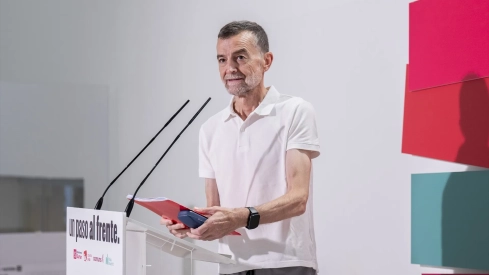
Izquierda Unida has raised its tone against Morocco from within the bloc that supports the Government and has warned that its latest movements put Spanish sovereignty "in danger." Its federal coordinator, Antonio Maíllo, has linked Rabat's threat regarding extraditions with its territorial claims over Ceuta and Melilla and with the Moroccan action during the massive entry on July 30.
The position has special weight because IU is part of Sumar and maintains representation in the Council of Ministers through Sira Rego, head of Youth and Childhood. Maíllo's words introduce a clear difference in tone compared to the Minister of Interior, Fernando Grande-Marlaska, who this Thursday tried to cool down the clash and defended that cooperation with Morocco will continue to function.
"The dictatorship raises the stakes"
Maíllo has accused the "Moroccan regime" of acting passively during a crisis in which, according to his assessment, more than a hundred people lost their lives. "And now the dictatorship raises the stakes, maintains the threat and claims Ceuta and Melilla," wrote the IU coordinator before launching a question also directed at the Executive: "Does anyone still doubt where the danger to our sovereignty lies?"
The reaction comes after the Moroccan Minister of Justice, Abdellatif Ouahbi, confirmed that his department is studying suspending the application of the bilateral extradition agreement. Rabat alleges problems in the delivery of people claimed by its courts and maintains that some operations are frustrated after mobilizing its agents to collect the detainee.
The agreement was signed in Rabat in June 2009 and came into force in September 2012. Its suspension would affect the delivery of people prosecuted or convicted of crimes in either of the two countries, a relevant cooperation in investigations into terrorism, drug trafficking, organized crime, and economic crime.
Ouahbi has also criticized Spanish regularization policy and has reiterated the historical Moroccan claim over Ceuta and Melilla. The Spanish Government has responded that the country's territorial integrity is outside of any negotiation. Margarita Robles assured during her visit to Ceuta that both cities are "super-Spanish" and that any attack against them constitutes an attack against all of Spain.
IU questions European border policy
The IU spokesperson in Congress, Enrique Santiago, has accused Morocco of "using migrants and refugees to attack Spain, while collecting money from the EU." The deputy, who also serves as Sumar's spokesperson for Justice and Interior, believes that Rabat is pressuring a state that applies its legal guarantees while receiving European funding to control migratory outflows.
Santiago has asked Brussels to take advantage of this crisis to "end the policy of externalizing borders." Between 2015 and 2021, the European Union committed 234 million euros for migratory programs in Morocco. In 2023, it added another program of 152 million aimed at strengthening border management, combating human trafficking networks, and financing voluntary returns.
Marlaska offered a very different reading this Thursday during his visit to Ceuta. The minister has ruled out Morocco suspending extraditions and has defined bilateral cooperation as "extraordinary and exceptional." He also assured that relations between both countries are based on trust and loyalty.
The Interior Ministry now estimates that about 5,000 people remain in Ceuta, including 1,898 minors already identified. The Government has resolved more than 500 adult cases and has requested judicial authorization to begin executing new expulsions.
Rabat's upcoming decisions will determine the real scope of the threat. While Marlaska trusts in preserving cooperation, IU demands a review of the relationship with Morocco and the European model that has turned the neighboring country into a central piece of migratory control.
