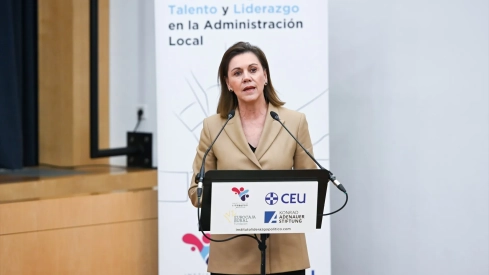
The PSOE has requested at the start of the trial of the Kitchen case that María Dolores de Cospedal be charged again and that the Popular Party be considered civilly liable for profit, based on “new” evidence that remained hidden for years. Among them stand out several audios from commissioner Villarejo in which, according to the prosecution, the former popular leader would acknowledge having accessed sensitive information from the PP's B-fund before the judge, in addition to intervening in maneuvers to stop the dissemination of the so-called Bárcenas papers.
The petition has been formulated by the PSOE's lawyer, Gloria Pascual, who has defended before the court of the National Court the need to assess these materials that, according to what she has pointed out, “have not been analyzed in a judicial setting”. The audios, incorporated into a separate part of the Villarejo case, remained under wraps for about two years and only recently have been able to be consulted by the parties.
Among the recordings, one stands out in which, according to the prosecution, Cospedal admits that she accessed police reports on the alleged irregular financing of the PP before judge Pablo Ruz, who investigated the 'B box' case around 2013 and 2014. Another audio refers to the well-known “little notebook” of Luis Bárcenas, while a third, dated 2017, records how Villarejo requests help from the former general secretary of the PP regarding his legal problems.
The Anti-Corruption Prosecutor's Office and the head of Central Investigating Court number 5, Antonio Piña, already rejected at the time reopening the investigation against Cospedal. In a ruling, the magistrate was especially critical of the PSOE's request, considering that the audios “do not contain sufficient incriminating elements” and accusing the party of acting “against procedural good faith”.
It will now be the court in charge of judging the Kitchen case that decides whether to admit these new proceedings. The socialist prosecution insists that the audios are “relevant and novel” to clarify the alleged parapolice operation that, according to the investigation, was launched from the Ministry of the Interior during the PP Government to steal evidence from Bárcenas.
The PSOE also requests that the Popular Party be considered civilly liable for lucrative title, understanding that it was the main beneficiary of the so-called Operation Kitchen. According to its thesis, the objective of the device was “to sabotage” the judicial investigations into the irregular financing of the party that Mariano Rajoy then led.
In parallel, the defenses of several defendants have raised preliminary questions to try to stop the trial. The lawyer for the former Minister of the Interior Jorge Fernández Díaz has maintained that the Audiencia Nacional is not competent to judge these facts, considering that there was no formal commission to Villarejo. “There was no contract, there was no price, there was nothing,” he argued.
Other former senior officials from the Interior Ministry have joined this line, such as Francisco Martínez, former Secretary of State for Security, and Eugenio Pino, former Deputy Operational Director of the Police, who have requested the nullity of the procedure and its transfer to an ordinary court.
