“It’s nauseating to see him sitting on the blue bench. He has covered up an alleged sexual assault, a rape. What disgusting feminism.”
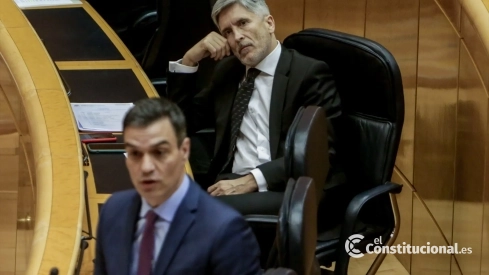
With that toughness, the control session of the Government in the Congress of Deputies has begun. The phrase, spoken by Miguel Tellado, has set the tone for a morning marked by the resignation of the operational chief of the National Police and by a clash of accusations that has raised political tension from the first minute.
Minutes before, in the corridors of the Lower House and before journalists, the Minister of the Interior, Fernando Grande-Marlaska, tried to close ranks: “We knew nothing; if we had known, his immediate dismissal would have been requested”.
They are the first public explanations from the highest political official of the body, who —as he has specified— requested information about the complaint as soon as he became aware of its existence, yesterday. Marlaska maintains that the most solid indication that there was no prior information is that the lawyer of the police officer, alleged victim, has stated that the complaint was kept in reserve until yesterday afternoon.
The resignation, in the last few hours, of the deputy operational director (DAO) of the National Police, José Ángel González, occurs after a court in Madrid summoned him to testify on March 17, after admitting a lawsuit against him for an alleged sexual assault. The latest political crisis has caught the President of the Government, Pedro Sánchez, on an official trip to India. But neither his absence nor that of seven other ministers has lowered the tension in the hemicycle.
In addition to Miguel Tellado, Ester Muñoz, and Jaime de Olano, other Popular Party deputies increased the pressure with a clear message: "Marlaska, resignation". The national spokesperson, Muñoz, went further by mixing this episode with other controversies and suggesting that the Executive coexists with a prosecutor general "who instead of prosecuting crimes, committed them", in allusion to the State Attorney General's Office.
As the morning progressed, the tone of the Minister of the Interior, Fernando Grande-Marlaska, hardened. “Say outside this chamber that I knew about the facts and did not act, and then we will see each other in other instances. These are accusations of such gravity that I will not allow slander,” he warned from the tribune, in response to the Popular Party deputy Miriam Guardiola, who maintained that “he cannot be at the head of the Ministry”.
Marlaska's most political statement came when referring to that resignation request, with a resounding phrase: he will only resign "if the victim asks me to".
No indications nor evidence: Moncloa defends management and acknowledges the “monumental anger” over opposition accusations
Sources from the Moncloa Palace unreservedly back the version of the Minister of the Interior, Fernando Grande-Marlaska. "We found out through the press and took an hour and a half to react", they assure in the circle of the head of the Interior. And they counterattack: "Those who did know about cases affecting their party and did not act were those of the Popular Party".
In private, they acknowledge a “monumental anger” over the political dimension the issue has acquired. They consider the accusation that the Executive was aware and chose to look the other way “serious.” “Things are being said without indications or proof,” they lament, before posing a question that summarizes their position: “Does anyone really believe this Government knew and did nothing?”
From Moncloa they insist on an element they consider key: the complaint was filed directly in a court, not at a police station. That procedural route —they emphasize— prevented the Ministry of the Interior from having prior knowledge of the events until they became public. With that argument, the Executive tries to shield its narrative and convey the idea that there was no omission, but rather an absence of information.
Add ElConstitucional.es as a preferred Google source for free.
Stay informed about all the latest breaking news with the best information. Against disinformation, for democracy and social rights.