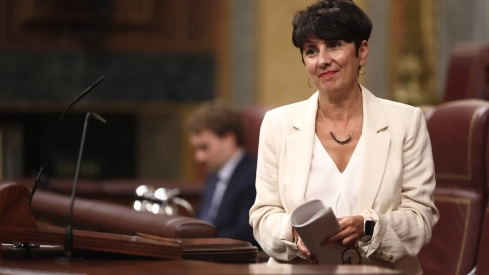
The PNV has directed this Thursday one of the harshest criticisms that Pedro Sánchez has received from the parliamentary bloc that allowed his investiture. Its spokesperson in Congress, Maribel Vaquero, has accused the president of reacting late to the Ceuta crisis, offering contradictory explanations, and failing to take advantage of his appearance to clarify what happened at the border on July 30 and 31.
"He has come to us with a self-congratulatory narrative. With all due respect, you have not been up to the task," Vaquero stated during the extraordinary plenary session. The Jeltzale leader recalled that Sánchez appeared a month after the massive entry and "the last, when he should have been the first."
The criticism carries special weight due to the PNV's political position. Its five deputies supported the investiture and have allowed the Government to push through decisive votes, although the relationship with Moncloa has been going through a more demanding phase for months. The party has warned about the absence of new Budgets and demands the fulfillment of commitments made with Euskadi, especially pending transfers in matters such as Social Security and ports.
The agreements reached at the beginning of the year allowed the negotiation to be channeled, but trust remains linked to the fulfillment of what was agreed upon. Vaquero's intervention has now shown that this distancing also extends to the management of Ceuta and the Executive's response to Morocco.
The PNV spokesperson has reproached the Government for the "dance of data" offered in recent weeks and the differences between ministries regarding the origin of the crisis. These fluctuations, she explained, have generated "perplexity, confusion, and distrust" among citizens who still do not know how an entry of such magnitude could have occurred.
"It was not just another migratory crisis," she warned. In her opinion, the Executive was unable to calculate the seriousness of what was happening and left a feeling of abandonment in Ceuta that Sánchez's appearance has not managed to dissipate either.
The PNV sees it implausible to exculpate Morocco
Vaquero has placed Morocco at the center of her reproaches. The spokesperson considers it impossible to explain that between 70,000 and 100,000 people reached Ceuta in less than two days without the Moroccan authorities knowing about the preparations or allowing movement towards the border.
"Morocco is not a reliable country", he affirmed before recalling a succession of disagreements that includes the Green March, the Perejil incident, disputes over airspace and territorial waters, the diplomatic crisis over the hospitalization of the Polisario Front leader, and espionage through Pegasus.
For the PNV, Rabat could have actively intervened or consented to what happened by looking the other way. Vaquero has requested the declassification of all documentation in the hands of the Executive and has warned that Sánchez's credibility will depend on the clarity and veracity of the information he publishes.
The president defended in his reply that he acts with prudence and with the available data. "I do not exonerate anyone," he assured, while asking to wait for the conclusions of the Security Forces and Corps regarding the indications pointing to Morocco. He also acknowledged that "things failed" in the information mechanisms and announced the publication of a dossier with reports related to the crisis.
Sánchez has again highlighted Moroccan collaboration in the return of nearly 90% of the people who crossed the border and has promised to act forcefully if solid evidence of Rabat's involvement appears. Vaquero considered that explanation insufficient and demanded to know what failed and what measures will be adopted to avoid another similar episode.
Human rights, security, and competencies for Euskadi
The PNV wanted to separate its position from discourses that present migrants as a threat. Vaquero defended that migration is necessary in an aging Europe, although she called for "responsible, orderly, and fair" management that addresses the phenomenon with realism.
The deputy maintained that the protection of human rights must coexist with border security, returns carried out in accordance with the law, and effective inclusion. The lack of management, she warned, fuels tension and strengthens the most polarized positions.
Vaquero took advantage of the debate to revive a PNV demand included in its negotiations with the Government. Euskadi wants to assume real competencies in immigration and participate directly in decisions affecting reception, integration, and security.
"We want to be an active political actor, with decision-making power and not a mere passive actor," concluded the jeltzale spokesperson.
