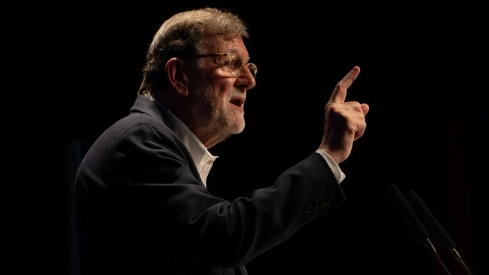
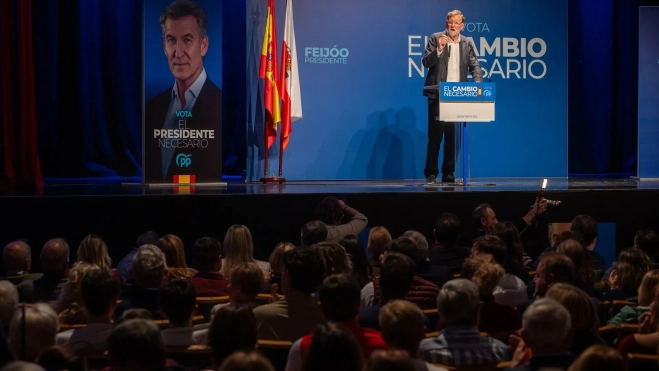
Mariano Rajoy returned last night to the PP's campaign with a request to right-wing voters and a bleak portrayal of Pedro Sánchez's years in La Moncloa. "We are living through the darkest period in Spain's recent history," he said at the Vimenor Theater in Vioño de Piélagos, Cantabria, alongside regional president María José Sáenz de Buruaga, and the head of the list for Congress, Isabel Urrutia. Eleven days before the general elections on 29N, the former president described the change of government as "essential and urgent" and presented Alberto Núñez Feijóo as the only candidate capable of achieving it.
Rajoy asked to concentrate the vote on the PP and warned that splitting it among different candidacies could cost seats. "One extremism cannot be opposed by another extremism," he said after claiming his party as a center-right formation with government experience. He avoided mentioning Vox in that appeal, although the PP and Santiago Abascal's party have already agreed to withdraw or limit candidacies in several constituencies for the Senate. In Piélagos, Rajoy's request pointed to the distribution of seats in Congress, from which the next investiture will emerge.
The former president also called for "an end to polarization" and recalled that the PP and PSOE had reached agreements on matters of State, such as the application of Article 155 in Catalonia during his mandate. In the same speech, he resorted to "Frankenstein" to refer to Sánchez's parliamentary support and said of him that he "never won the elections." Sánchez came to the presidency in 2018 through the motion of no confidence that ousted Rajoy with 180 votes in Congress. The following year, as a candidate, he led the PSOE to win both general elections in 2019, with 123 seats in April and 120 in November.
The homes Rajoy claims are non-existent
Rajoy asserted that no homes had been built in the last eight years. The Cantabrian PP itself reported that he had put the number of homes built in both Cantabria and Spain as a whole at "zero". Data from the Ministry of Housing refutes this claim. In 2024 alone, 100,980 new-build homes were completed in Spain, the highest figure in twelve years. In 2025, nearly 92,000 were completed, according to the Housing and Land Observatory series.
The problem lies in the construction pace. In the first half of 2026, 51,406 free and protected homes were completed, while around 112,000 households were created, according to the comparison made by CaixaBank Research with data from Housing and the INE. The Bank of Spain has been pointing out that supply responds slowly to the increase in demand, a gap that helps explain the pressure on prices and is evident even in the years when more homes have been completed.
The former president also questioned the functioning of the railway and recalled the punctuality of the AVE during his mandate. In the economic chapter, he cited the 4.9% year-on-year inflation in October, confirmed by the INE. The rising cost of the shopping basket coexists with an increase in employment. In the third quarter, there were 22.85 million people employed, 465,500 more than a year earlier, and the unemployment rate remained above 10%.
Three extensions and 2023 accounts
The lack of new Budgets was one of Rajoy's most enduring reproaches. The 2023 accounts have been extended into 2024, 2025, and 2026, so the Executive has continued to work with a spending structure approved before the last general elections. Rajoy argued that this situation had allowed the Government to spend without the corresponding parliamentary control.
The extension is automatic and is provided for in article 134 of the Constitution. As the Independent Authority for Fiscal Responsibility reminds, spending modifications are still subject to rules and some require a law. The AIReF does warn that in 2026, exceptions to these rules have been resorted to more frequently through decree-laws. The difference matters because it is one thing for Congress to have spent the legislature without voting on new accounts and another how spending is authorized and overseen during the extension.
Feijóo asks for "borrowed" votes from the PSOE
While Rajoy asked in Cantabria for the right to concentrate the vote, Feijóo sought out undecided voters, those considering abstaining, and former PSOE voters in Logroño. "I ask many socialists for their borrowed vote," he said at the Riojaforum, where he shared the stage with the president of La Rioja, Gonzalo Capellán, and the head of the list for Congress, Cuca Gamarra. The PP leader took advantage of the lead given by several polls to pressure his own. He said that "everything smells" like things will go well for them and, immediately afterwards, reminded them that "nothing has been done here."
Pedro Sánchez huyó de Paiporta, se fue de vacaciones mientras invadían Ceuta y no acudió al funeral por las víctimas de Urda.
— Partido Popular (@ppopular) November 17, 2026
Necesitamos un presidente que dé la cara. pic.twitter.com/hNdmCVHzWC
Feijóo attacked Sánchez with the phrase "Spain needs a servant and not an impostor" and committed to Capellán to execute the infrastructure pact of La Rioja. Among the promises he left at Riojaforum is to increase train frequencies between Logroño and Madrid through La Rioja Baja, with at least one stop in Calahorra. He set a goal for the Riojan PP leaders for 29N, to win three seats in Congress.
Contact
We are listening. Get in touch.
