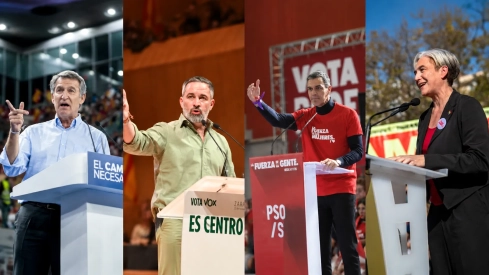
The President of the Government and candidate of the PSOE for re-election, Pedro Sánchez, the leader of the PP, Alberto Núñez Feijóo, the president of Vox, Santiago Abascal, and the candidate of Frente Amplio, Ada Colau, will star this Thursday in the last electoral debate before the general elections on November 29, an event that, according to the campaign approach, will clearly delineate the two blocs competing for the Presidency of the Government.
The meeting, organized by the Television Academy, will begin at 10:00 PM and will be held just three days before the polls open, with a structure similar to the face-to-face debate held a week ago by Pedro Sánchez and Alberto Núñez Feijóo. On this occasion, the four main candidates will debate on housing, economy, social policies and other issues on the electoral agenda, in a broadcast that can be followed through different television channels.
Two blocs face to face in the final stretch of the campaign
The event will serve to visualize the struggle between the two blocs aspiring to lead the next Government, with Pedro Sánchez and Ada Colau positioned on the left wing, facing Alberto Núñez Feijóo and Santiago Abascal in the center-right space. The format, as planned by the organization, will seek for the candidates to confront their proposals directly and become one of the last opportunities to attract undecided voters.
In the general elections of July 23, 2023, Feijóo declined to participate in the four-way debate then organized by RTVE and left the chair empty in that televised duel, which pitted Sánchez, Yolanda Díaz and Abascal. In this electoral cycle, the leader of the PP and the leader of Vox will share a debate for the first time, although popular sources already anticipate that the PP candidate will not seek a clash with Abascal, but with the head of the Executive.
Pedro Sánchez insists on the presidential profile
Pedro Sánchez's campaign team maintains the strategy deployed in last week's face-to-face debate, despite the fact that most analysts considered the socialist to be the loser. Sources close to the President of the Government indicate that he will maintain a similar line, without entering into direct confrontation with the right-wing candidates and preserving what is called "good manners".
According to those same sources, Pedro Sánchez will once again opt for a "presidentialist" profile, understanding that citizens valued his avoidance of confrontation with his opponent and that this attitude is already beginning to be reflected in the polls, which point to a slight rise for the socialist leader since last Thursday. The Prime Minister's intention is to address the less politicized and still undecided voter, to dismantle the image that the right has built of him in recent years, described by his entourage as that of an arrogant and amoral person.
Socialists believe that the left-wing electorate is already sufficiently mobilized and are concentrating their last efforts on the center of the ideological spectrum, with the idea of conveying that Pedro Sánchez has been "a good Prime Minister" and of confronting the model represented by PP and Vox.
Feijóo will seek to confront Sánchez and demand explanations
Alberto Núñez Feijóo faces the debate with "calm" and with the intention of subjecting Pedro Sánchez to a "critical and demanding examination" of his management. In Génova, the national headquarters of the PP, they admit that the popular leader will seek a clash with the Prime Minister to confront two models, but not with Santiago Abascal.
The popular party maintains that Feijóo won "by a landslide" against Sánchez in the face-to-face debate a week ago and aspire to repeat that result in this Thursday's debate. In that context, they also believe that Ada Colau "is playing for high stakes," considering that the "extreme left" is being "fagocited" and that the Frente Amplio candidate will have to decide whether to continue being "the PSOE's sugar daddy" or to start distancing herself from a party that, in the opinion of popular sources, is "corrupted."
Alberto Núñez Feijóo himself anticipated on Monday, in an interview on Telecinco, that he expects Sánchez to try to equate him with the president of Vox. "I imagine he's going to do something like that, right? Feijóo-Abascal, Feijóo-Abascal, Feijóo-Abascal. But I'm not too worried about it either," assured the leader of the PP.
Feijóo will attend the debate with the same team that accompanied him in the face-to-face with Sánchez: the national spokesperson for the PP, Borja Sémper; his chief of staff, Marta Varela; his right-hand woman for 30 years, Mar Sánchez; the PP's Communications Director, Luis de la Matta; and Lucas Martinón, one of his main advisors when he was head of the Xunta de Galicia.
Abascal speaks of calm and Colau focuses the message on housing
For his part, Santiago Abascal faces the event with "tranquility," after preparing for the debate "studying" the topics that will come up and "listening" to Spaniards, with the intention of bringing "the concerns" of the citizenry to the set, as he explained on Monday in statements to the media in Segovia.
Vox will open its national headquarters, located on Madrid's Bambú street, so that interested media can follow the debate organized by the Television Academy from there, although the assessment of the meeting's development will presumably be made at Secuoya's Madrid Content City facilities in Tres Cantos, where the event is being held.
In the case of Ada Colau, the Frente Amplio candidate will attend the debate with the aim of confronting Feijóo and "debunking him with data," unlike what happened in the face-to-face with Sánchez, who, according to Colau herself, lacked forcefulness and maintained an attitude of "downcast arms" to refute the PP leader.
"We are not going to let the right tell a lie and get away with it. People deserve a real debate, not a slogan contest," sources from her candidacy have conveyed, also emphasizing that Colau will be the only woman in the debate. Her team has thoroughly prepared for the event, with Frente Amplio specialists in different areas, especially in housing, social rights, and feminism, while reviewing other debates and refining a strategy that places rent reduction as one of the first measures she will defend if she governs alongside the PSOE.
Contact