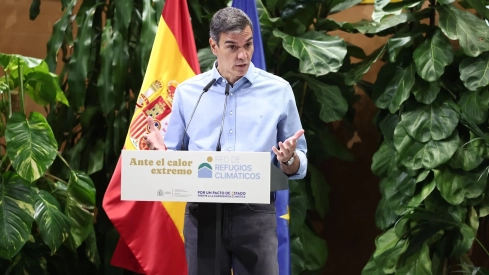
The acting President of the Government, Pedro Sánchez, raised the tone this Monday against the management of the Community of Madrid by reopening the controversy over the high temperatures recorded in schools at the end of the school year. Sánchez took advantage of the closing of the presentation of the Network of Climate Refuges, held at the headquarters of the Ministry for Ecological Transition and the Demographic Challenge to defend that administrations must act against extreme heat and questioned the attitude of the Madrid Executive in the face of complaints from families and students.
The head of the executive insisted that the increase in temperatures forces administrations to adapt educational spaces and rejected that the problem can be minimized. "In the face of extreme heat, the obligation of all public institutions cannot be based on seeking excuses or denying the evidence," he stated, before defending that centers must be conditioned to guarantee the safety of students.
The president also added that "from the privilege of those who live and work with air conditioning or can take refuge in a second home with a pool," a reality that, he said, is far from what millions of Spanish families experience.
The Community of Madrid defends its plan against heat
Sánchez's words revive a controversy that marked the end of the school year, when the high temperatures recorded in several educational centers in Madrid provoked criticism from families and teachers. The Minister of Education, Mercedes Zarzalejo, responded to these complaints that "when it's hot, it's hot" and vindicated the actions undertaken by the Community in terms of air conditioning in educational centers.
From the regional Executive, they maintain that the community has had a specific protocol for extreme heat episodes since 2023, which allows schools to adapt their activity when meteorological conditions require it. This plan also includes actions aimed at improving the thermal insulation of buildings, reinforcing electrical installations, and advancing in the air conditioning of centers, with the aim of reducing the impact of high temperatures in classrooms.
Sánchez links fires to the climate crisis
The president also took advantage of his speech to place forest fires within the debate on climate change. Without focusing solely on the fires that remain active in different parts of the country, Sánchez argued that Spain faces a scenario that requires strengthening prevention and adaptation policies.
During his speech, he conveyed a message of support to the residents affected by the fires and to the emergency teams deployed on the ground, while warning that the country no longer faces exceptional phenomena. In his opinion, heat waves and large fires are part of an increasingly frequent reality that forces administrations to act in advance.
In that sense, he recalled that more than 150,000 hectares have burned so far this year and thirteen people have died as a result of forest fires, figures he used to argue that the fight against the climate emergency must become a political priority. "It is not enough to react when the consequences arrive," he maintained, but, he added, it is necessary to prepare the country to minimize its effects on the population.
After the event, Sánchez reinforced that same message on his X account, where he described the State Pact against the Climate Emergency as a "national priority" and argued that the response to this challenge requires the involvement of all administrations and society. "This battle will not be won by a government alone. It will be won by a united country, aware of what is at stake and determined to protect its territory, its future and the lives of its people," he wrote.
Urgen soluciones que construyan una España más segura, más habitable y preparada para los desafíos futuros.
— Pedro Sánchez (@sanchezcastejon) July 27, 2026
El Pacto de Estado frente a la Emergencia Climática es una prioridad nacional que nos atañe a todos.
Esta batalla no la ganará un Gobierno en solitario. La ganará un país… pic.twitter.com/6nsTZdDyOe
Add ElConstitucional.es as a preferred Google source for free.
Stay informed about all the latest breaking news with the best information. Against disinformation, for democracy and social rights.
