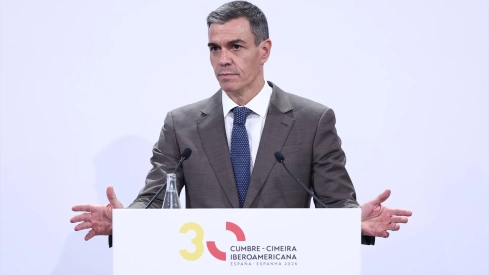
The President of the Government, Pedro Sánchez, has warned that governments' commitment to peace "has weakened" in recent decades, a process that, in his opinion, pushes the world towards "a new world war" in a context marked by militarization and confrontation.
He states this in an article published in the American magazine Foreign Affairs, under the title The World's Last Chance for Peace, in which he rejects that war should be assumed as "something inevitable" and calls for a stronger international response to the deterioration of the global order.
"War" can no longer be assumed as something normal
Sánchez argues that wars of aggression, including those in Ukraine, Lebanon, and Iran, are increasing and sowing "horror, ruin, and the fear of a global confrontation," while governments increasingly think of war as something to prepare and budget for.
In his analysis, the head of the Executive considers it "dangerous" to normalize international conflict and recalls that the devastation caused by the two world wars of the 20th century led countries to a common endeavor for war to cease being a legitimate instrument of state policy and become an illegal act.
However, he denounces that this commitment has weakened in recent decades, especially since the US-led invasion of Iraq in 2003. "Since then, the pursuit of peace has been receding on the international agenda," he states in the text.
Criticism of militarization and multilateral indifference
Pedro Sánchez warns that growing geopolitical competition, coupled with neglect or indifference towards multilateral efforts that for decades curbed war, leads to a scenario of "new world war." Therefore, he appeals to governments like Spain's to act "to limit the capacity of others to wage war" and to strengthen international institutions, which, he stresses, "must be guarantors of peace."
The President of the Government advocates for an "expansive multilateralism," which he prefers to call "maxilateralism," understood as cooperation that encompasses the largest possible number of countries, instead of being limited to small "ad hoc" coalitions.
In this framework, he warns that war is being considered as "something normal," particularly after aggressions that, he points out, violate the United Nations Charter, such as the Russian invasion of Ukraine or the attacks by the United States and Israel on Iran, while fighting continues year after year in places like Lebanon, Sudan, and Yemen.
"To be silent is an act of cowardice and complicity"
Sánchez also links this trend to military budgets that, he says, "have soared to levels not seen in generations," to the detriment of social and development spending, even in countries with a long tradition of military restraint, such as Germany, Denmark, Japan, and Norway, as well as with the reintroduction of military service.
Furthermore, he mentions the return of the threat of nuclear war and the emergence of artificial intelligence (AI), to which he attributes a growing capacity to equip war with increasingly dangerous weapons. "Together, these dynamics multiply the probabilities that any crisis will quickly lead to the annihilation of the planet," he warns.
In this context, the President of the Government also warns that "countries are manufacturing the instruments of catastrophe at the dizzying speed of innovation, while the instruments of control advance at the much slower pace of diplomacy."
Therefore, in the article, Sánchez argues that political changes are moving the world away from peace and pushing it towards militarization and confrontation, and asserts that remaining silent in the face of this international situation is "an act of cowardice and complicity."
Rejection of 5% of GDP for defense
In his article, Pedro Sánchez reaffirms the Spanish position of not assuming the defense spending target of 5% of GDP proposed by the North Atlantic Treaty Organization (NATO), understanding that security grows when societies are resilient, inequalities are reduced, and citizens can trust public institutions.
The head of the Executive asserts that the Spanish Government has shown its commitment to European defense and that it is "one of the main drivers of the European Union's strategic autonomy." In this regard, he recalls that Spain has tripled defense spending since 2018, when he came to Moncloa.
Sánchez adds that maintaining proportionate defense spending has allowed for an additional 145 billion euros to be invested in social protection, housing, health, and education, and more than 30 billion in the ecological transition. "These are policies that unite society and, therefore, make it safer," he states.
Reforms to strengthen multilateral institutions
The President of the Government also proposes strengthening multilateral institutions through far-reaching reforms so that they have the capacity to act in the pursuit of peace and security. Among his proposals is to update the structure of the United Nations Security Council, whose permanent seats and veto power, he recalls, are still reserved for the five victorious powers of World War II, which together account for barely a quarter of the world's population and do not reflect the current world.
He also proposes expanding the number of elected members of the Council and granting these new positions mainly to countries from underrepresented regions, particularly Africa and Latin America. He also calls for strictly restricting the veto power of permanent members, especially when the Council deliberates on cases of mass atrocities, genocide, crimes against humanity, and war crimes.
Finally, Sánchez calls for a structural transformation of international financial institutions, especially the International Monetary Fund (IMF) and the World Bank, considering that the distribution of voting power still reflects the economic balances of the 20th century and that the tradition by which a European heads the IMF and an American the World Bank "must end."
Contact