Tension rose again this Thursday in Ceuta after a demonstration that ended with the burning of part of an improvised settlement on Trampolín beach. The disturbances have provoked political reactions and, this Friday, Sumar has placed the president of the autonomous city, Juan Jesús Vivas, at the center of its criticism for his management of the migratory crisis.
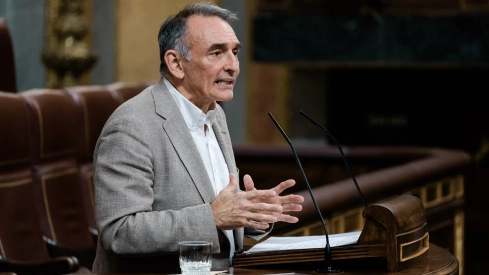
Sumar's spokesperson for Justice and Interior in Congress, Enrique Santiago, has attributed "clear responsibility" to Vivas for the violent episodes recorded during the night and has demanded that the Popular Party condemn the events in a "radical and forceful" manner. The deputy has especially denounced the burning of the shacks where some migrants were.
During his statements to the media before the extraordinary session of the Congress's Interior Committee dedicated to the situation in Ceuta, Santiago questioned the discourses that, in his opinion, present the return to Morocco of all the people who arrived in the city as a solution. He considers that proposing a generalized return does not conform to reality and has urged to abandon this type of proposal to seek alternatives that allow reducing the pressure on the autonomous city.
In this regard, he criticized Vivas for continuing to defend this path and demanded "to put our feet on the ground" to address the migratory situation from a perspective that he considers viable.
Santiago has also considered it especially "unacceptable" that the altercations coincided with the visit to Ceuta of former Prime Minister José María Aznar. The Sumar leader has linked the violent episodes to the actions of "radical ultras" and has asked the PP to clearly distance itself from this type of behavior.
But the deputy has warned that the consequences of this escalation go beyond the migrants themselves. As he pointed out, the violence is also beginning to affect the Muslim community of Ceuta, which is why he has warned that the coexistence between the different groups that make up the city is at stake.
Given this scenario, Santiago has defended as an alternative organizing the transfer to the Peninsula of those people who cannot be expelled. The IU spokesperson in Congress has insisted that this option is necessary given the impossibility, in his opinion, of executing a generalized return to Morocco, a country which he has assured "will not accept any return."
Santiago has thus demanded a response that allows reducing pressure on Ceuta and preventing the migratory crisis from leading to new episodes of violence that could jeopardize social coexistence.
Tension soars in Ceuta
Ceuta is experiencing a moment of growing tension since, between July 30 and 31, around 70,000 migrant people entered the autonomous city. This Thursday, several altercations were registered. The first of them occurred when a group of migrants attacked several soldiers. Hours later, a group of Ceutians prevented a Red Cross truck from accessing Trampolín beach to distribute food among the migrants. Subsequently, that same group set fire to an area of the improvised settlement installed on the land.
On Thursday afternoon, a peaceful demonstration was called to protest against the management of the Government of Pedro Sánchez in the migratory crisis of the autonomous city. However, a group of the protesters changed the direction of the mobilization to initiate violent attitudes against the migrants.
"Invaders, expulsion" or "Ceuta is not for sale, Ceuta defends itself," were some of the chants heard during the concentration. In addition, among the attendees, flags of Spain and Ceuta could be seen, as well as some banners with Carlist symbolism.
The violent events took place after several people who were at the concentration prevented the access of a Red Cross truck that was going to distribute water and food among the migrant people.
Add ElConstitucional.es as a preferred Google source for free.
Stay informed about all the latest breaking news with the best information. Against disinformation, for democracy and social rights.
