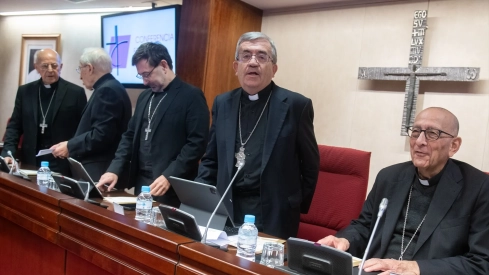
The Catholic Church finds itself once again in the midst of the Spanish political debate, but this time due to a division within its own ranks. The bishops have halted the initiative of their president, Luis Argüello, who intended for the Spanish Episcopal Conference (CEE) to publish a document with criteria to guide Catholics in the upcoming general elections on November 29. The proposal did not gather the necessary support and ended up blocked in an internal vote held during the Plenary Assembly.
The initiative carried significant political weight. Argüello wanted the institution to revive the electoral guidelines it has not published since 2011, when Mariano Rajoy arrived at La Moncloa. The document aimed to address issues that are part of the main ideological debates in Spain, such as abortion, euthanasia, subsidized education, and the political situation. The intention was to convey to the faithful a series of criteria based on Church doctrine for them to consider when voting.
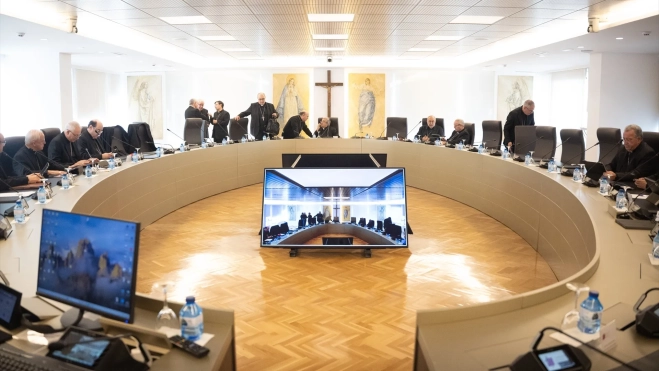
However, the proposal did not convince some of the bishops. The text obtained a favorable relative majority, but it did not reach the two-thirds required to become an official declaration of the Plenary Assembly. The result represents a setback for Argüello and shows that there is no common position on how far the institution should go in the electoral debate.
What did Argüello intend and why has it caused a confrontation among the bishops?
To understand the conflict, one must go back to the announcement Argüello himself made when inaugurating the Plenary Assembly. The president of the Episcopal Conference, Archbishop of Valladolid, made it clear that he wanted the bishops to speak out on the upcoming general elections. "I hope that this Assembly can offer some statement in this regard," he noted, after explaining that he did not want to make a direct reference to the elections in his speech.
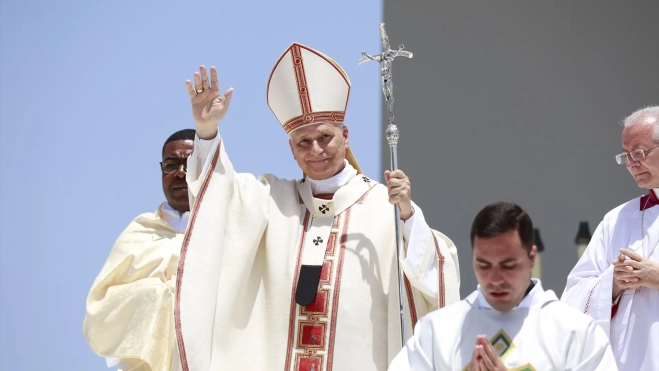
His proposal sought to take as a reference the speech that Pope Leo XIV delivered in the Congress of Deputies and transfer its approaches to the Spanish electoral context. Among the issues that Argüello wanted to include were matters such as the defense of life from conception to its natural end, a position linked to Catholic doctrine on abortion and euthanasia, in addition to other social and political debates.
The problem arose when the proposal was submitted to the rest of the prelates. During the meeting, three sectors were defined: those in favor of supporting Argüello's document, those who advocated maintaining institutional neutrality, and an intermediate group that accepted a possible declaration, but without entering into particularly controversial issues. This last sector argued that any pronouncement should be limited to general terms and avoid addressing issues such as abortion, euthanasia, the Ceuta crisis, or subsidized education. The discussion ended up leaving the text presented by the Presidency without sufficient support.
The Church avoids guiding the vote towards specific political positions
The rejection also reflects the fear of some bishops that a declaration of these characteristics could be interpreted as an electoral recommendation favorable to certain parties. One of the prelates present at the meeting explained to elDiario.es that the decision sought to prevent the institution from appearing as a guide for the vote of the right and the far-right. "It has been decided not to interfere in the elections, much less to do so in terms that would place us, in the eyes of public opinion, as guides for the vote of the right and the far-right," he assured.
In this way, the Episcopal Conference maintains the line followed since 2011, when it stopped publishing specific documents with voting guidelines for general elections. Although the final note of the Plenary Assembly, scheduled for this Friday, could encourage the faithful to participate in the polls and include references to Leo XIV's speech in Congress, it will not include the specific recommendations that Argüello intended to promote.
Contact
We are listening. Get in touch.
