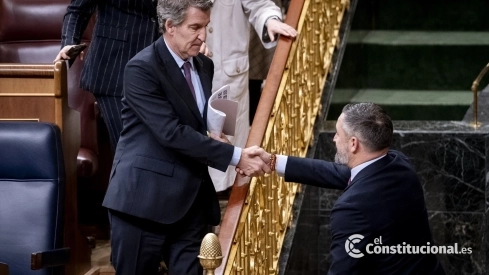
The week began with an initiative by Vox in Congress: to prohibit the burqa and niqab in public spaces. A debate that—I suspect they know this well—awakens intense emotions, slides without data towards insecurity and crime, and forces a stance. Also for the parties.
Who would not be in favor of eliminating any symbol that makes women invisible and subjugates them?
But while I try to answer some basic questions to rigorously address a complex issue, other headlines do not stop calling us as a society: nine women murdered by gender-based violence. One crime every five days so far in 2026.
I return to the origin of the debate. How many women in Spain wear a burqa or niqab? There is no official figure. According to the Association of Muslim Women of Catalonia, a count has never been made, although they estimate that there would not be a hundred in the whole country. First conclusion: we are facing a residual phenomenon. Immediate reflection: if a single woman were being forced to cover herself against her will, it should concern and occupy us.
But the key question is another. Is it really women's freedom that drives Vox —and the Popular Party, which adopted its framework by voting in favor— or are we facing an identity debate wrapped in the flag of security, national defense, or traditional values?
What was heard in Congress was not a feminist plea. It was something else.
"How much more do rapes and sexual assaults have to increase in our country for you to recognize this very serious error of multiculturalism?", exclaimed the Vox deputy Blanca Armario, without providing a single piece of data to support that relationship.
The newspaper archive is stubborn. And reality too.
Maybe your honor doesn't know who Pilar was. She was 38 years old. She was the first woman murdered this year by her ex-partner in Quesada (Jaén). He was Spanish.
Also Spanish was the man who murdered Tatiana Rodríguez in her home, in the midst of a separation. And the 35-year-old man who killed his ten-year-old son with a 60-centimeter machete and left his partner seriously injured in Arona, Tenerife.
None wore a burqa. None wore a niqab. None represented “multiculturalism”.
The problem was not the origin. It was machismo.
Some considerations for the legislator
We can debate symbols. Even legislate on them if there is social consensus and legal backing. It would not be the first time a European state has done so. But it is advisable not to simplify or make easy comparisons. The far-right already does that.
The burqa is not comparable to a nun's habit. But it is also not advisable to idealize what is our own while problematizing what is foreign. Female religious orders are integrated into a hierarchical structure headed by men who decide and condition their organization and internal life. The difference is that this hierarchy is part of our tradition and we have normalized it. It makes us less uncomfortable because it is "ours". The debate, therefore, should not revolve around isolated symbols, but around the real freedom of women, regardless of the religion they profess.
If the preamble of a future law appealed to security, we would have to be coherent. We would also have to look at those who cover their faces in far-right demonstrations—such as those called by Núcleo Nacional—or at any group that uses anonymity to shield violent behavior.
In parallel, another question: where does the voice of Muslim women, about whom legislation is desired, remain? Has anyone bothered to speak with them before turning their clothing into a state matter?
María del Carmen Navarro Granados, professor of Theory and History of Education at the University of Seville, and Juan García-Fuentes, professor at the University of Granada, surveyed 1,157 Muslim people in the study Muslim Woman and Discrimination in Spain. Orientations for Professionals in the Educational Field. One of the data points is eloquent: 80.7% state they have felt discriminated against in Spain for being Muslim in recent years.
To legislate without listening to the group in question is always a bad strategy. Perhaps the path lies through the subcommittee registered by the PNV so that experts, jurists, associations, and, above all, Muslim women, take the floor before turning a symbol into a criminal problem.
But while we focus on a phenomenon that affects—according to the associations themselves—fewer than one hundred women, every five days another woman is murdered in Spain by the man who claimed to love her. And on that, despite legislation existing for more than twenty years, the political debate is no longer so heated. Nor is social mobilization as constant.
The question is not whether we should ban the burqa. The question is why we continue to fail at the urgent while turning the marginal into a political priority.
If we are truly talking about protecting women, let's start where they are dying.