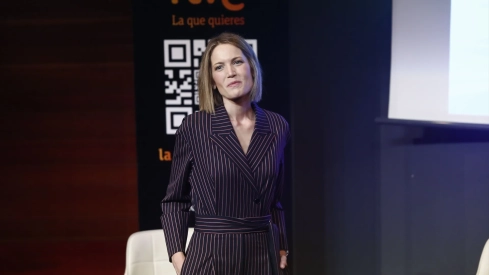
The Federation of Associations of Journalists of Spain (FAPE) has demanded that the Central Electoral Board (JEC) withdraw and archive the disciplinary proceedings opened against Silvia Intxaurrondo. The organization considers that the decision constitutes a "disproportionate response" and has warned of the consequences it may have for the exercise of journalism, especially during electoral periods.
In a statement published this Tuesday, November 24, the federation expressed its concern about the procedure opened against the presenter of 'La hora de La 1' and highlighted the precedent it could set. In its opinion, the problem is not in evaluating the questions Intxaurrondo asked, but in the Electoral Board having initiated disciplinary proceedings against a journalist individually.
"A procedure directed against a professional personally, when what is at stake is a responsibility that the law places elsewhere," said FAPE, which insists that it does not intend to judge the content of the presenter's interventions, but to question the instrument used by the electoral body.
FAPE reminds that responsibility lies with public media
The federation bases its position on Article 66.1 of the Organic Law of the General Electoral Regime (LOREG), which establishes the obligations of political pluralism, equality, and informational neutrality during electoral processes. According to FAPE's interpretation, these requirements correspond to the organization of public media and their control bodies, and should not be automatically transferred to each journalist individually.
The organization also reminds that, to attribute disciplinary responsibility to a specific person, the conduct considered reprehensible must be precisely defined, as required by the principle of sanctioning legality set forth in Article 25 of the Constitution.
For this reason, it considers that opening a personal file against Intxaurrondo adds a formal reproach that is unnecessary to guarantee the neutrality of public media. FAPE describes the Board's action as a "disproportionate response" and demands that the procedure not go forward.
FAPE's warning: the risk of self-censorship in electoral campaigns
Beyond the Intxaurrondo case, the federation's main concern is the effect this decision may have on all information professionals. The organization maintains that the file does not only affect a presenter or a program, but that it can impact journalists from all editorial lines and all public media, both state and regional.
FAPE has warned that the possibility of facing a sanctioning procedure for their interventions can lead many professionals to avoid certain matters of public interest during electoral campaigns. "The risk is that many will opt for self-censorship when dealing with matters of public interest in a campaign given the threat of a sanction," the statement warns. The federation considers it especially worrying that journalists may feel conditioned when asking questions, opening debates, or addressing controversial issues precisely at times when citizens need to have plural information.
Likewise, it wanted to make it clear that its position does not depend on who the affected professional is, the medium in which they work, or the political party that files a complaint. "It will maintain this same position regardless of the medium, the editorial line of the affected professional, or the political formation that files the complaint," it assures. The organization concludes by asserting the right of citizens to receive free and truthful information and demands that the exercise of journalism be protected against actions that may limit public debate.
Contact
We are listening. Get in touch.
