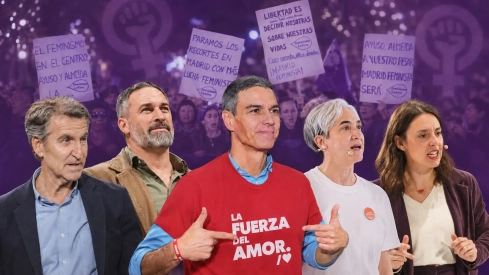
Spain reaches 25N with 47 women murdered by their partners or ex-partners so far this year, six more than on the same date in 2025. Another 38 minors have been orphaned. The latest balance from the Government Delegation against Gender Violence, updated on November 23, raises the number of fatal victims to 1,388 since 2003. Behind the count are families who will face this International Day for the Elimination of Violence against Women with an absence that no electoral campaign can repair.
The commemoration coincides with the last four days before the general elections on 29N. The five main state parties are running with proposals that affect aid, housing, courts, and the protection of victims' children. PSOE, Frente Amplio, and Podemos propose expanding the public response, with differences in their scope. The PP promises to maintain the State Pact while considering an agreement with the far-right Vox, which demands an end to the current model.
The far-right Vox wants to repeal the laws that the PP promises to maintain if it governs
The far-right has taken its offensive against equality policies to city councils on the eve of 25N. The leadership of Vox has sent its municipal groups a text demanding "an end" to the protection system, which it considers a "failure," and the withdrawal of funding from entities it describes as ideologized. Its electoral program promises to repeal the laws that, it claims, have criminalized men. The cut would affect a network of associations that provides support and assistance to victims.
Santiago Abascal's party uses the persistence of murders to discredit all policies against sexist violence. The 2026 balance has worsened compared to the same time last year, but the historical series also does not support a continuous increase over two decades. In 2004, 72 women were murdered by their partners or ex-partners; in 2025, 48. This evolution does not allow all changes to be attributed to one law, although it does deny that the number of victims has grown steadily since its approval.
The PP's program recognizes gender violence and expressly maintains the State Pact, whose compliance it promises to evaluate annually. It proposes more police and judicial resources, integrating regional and municipal assistance services into VioGén, and transferring the supervision of control devices for restraining orders to the Ministry of Interior. Feijóo has focused his latest interventions on the deficiencies of electronic monitoring bracelets and on accusing the Government of using feminism as propaganda.
The political contradiction appears in its potential partners. The popular candidate assured on Monday that equality laws and LGTBI rights are "untouchable," but at the same time defended the possibility of reaching agreements with Vox. Preserving these guarantees would require rejecting the repeals demanded by Abascal. Post-election negotiation would test that promise and determine what capacity the far-right would have to condition resources and protection policies.
The left proposes more aid, housing, and protection for children
The PSOE proposes an organic law against vicarious violence, which is exercised against children to harm their mothers, and a public network for trauma care for women and minors. Its program includes mandatory and evaluable training for police and judicial professionals, improvements in risk assessment, and a public registry of alimony debtors. Economic dependence also enters its proposals, with measures against non-payment used to prolong control over victims.
Frente Amplio proposes increasing funds against sexist violence by 10% annually, guaranteeing stable financing, and prioritizing victims in access to public housing. It also proposes to provisionally suspend visits and communications of parents investigated for certain types of violence while there is a risk to minors. Its commitment to dedicate at least 5% of the non-financial state budget to equality covers all these policies. Ada Colau has reproached Sánchez and Feijóo for sexist violence being left out of the center of their face-to-face debate.
Podemos brings to 29N a contingency fund of 1,000 million euros to sustain policies against all forms of gender-based violence. It adds a benefit equivalent to the minimum wage for six renewable months, extendable depending on dependents, and an immediate housing alternative. Irene Montero's candidacy also proposes evaluating care and protection services, including the bracelet system, and improving the working conditions of professionals who accompany victims.
The three forces advocate for enshrining abortion in the Constitution, although their programs differ on other feminist issues. The PSOE insists on an abolitionist law for prostitution; Frente Amplio includes labor rights and social protection for those who practice it, along with the prosecution of trafficking. These differences would coexist in an eventual progressive majority and would require specific agreements, also on how much money is allocated to each measure and how its application is guaranteed throughout the territory.
Protection must come before the complaint
There is a fact that forces us to look beyond the toughening of sentences. 34 of the 47 women murdered this year had not filed a previous complaint. The figure points to the need to detect violence from health centers, social services, and the close environment. Having one's own income, having a home, and finding professional support are conditions that can facilitate leaving an abusive relationship.
The electoral competition has incorporated this concern, but also the dispute over who represents feminism. The head of Equality of the PSOE, Pilar Bernabé, has called to fill the streets on 25N and the ballot boxes on 29N. Montero described gender-based violence this Tuesday as a "frequent, invisible and widespread" violation of human rights. The proposals for housing, economic autonomy, and specialized care allow examining what each candidacy offers beyond its appeals to the female vote.
The programs leave commitments whose fulfillment can be verified after Sunday. The PP promises to account for the State Pact; the PSOE, mandatory training and better risk assessments; Frente Amplio, annual funding increases; Podemos, a benefit and immediate accommodation. Applying them will require personnel, budget, and coordination with communities and city councils, which manage a good part of the daily care for women and their children.
Contact
We are listening. Get in touch.
