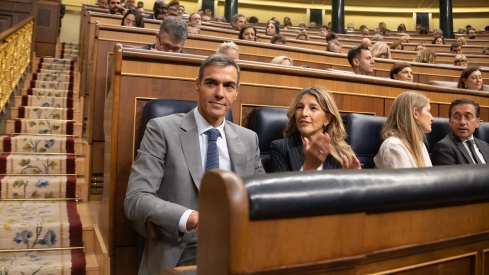
The Council of Ministers is scheduled to approve this Tuesday a 4.5% increase for public employees and raise the interprofessional minimum wage (SMI) to 1,286 gross euros per month in 14 payments. The President of the Government, Pedro Sánchez, announced both measures in an interview on Informativos Telecinco. Both will apply from January 1, 2027.
The new SMI means 65 euros more per payment, an increase of 5.3%. The second vice president and Minister of Labor, Yolanda Díaz, announced on Monday on Al Rojo Vivo that the Executive also plans to approve the fiscal adjustment so that workers perceive the increase "in full." To do this, the Government must legally extend the IRPF deduction that already applies to the 2026 minimum wage. According to Díaz, both decisions will be adopted this Tuesday.
The 4.5% for public employees is part of the agreement until 2028
The 2027 increase is the largest of those foreseen in the Executive's framework agreement with CSIF, CCOO, and UGT, which contemplates an overall increase of 11% between 2025 and 2028 for more than three million public employees. The calendar includes 2.5% for 2025, a fixed 1.5% for 2026 with a possible half-point supplement, 4.5% for 2027, and 2% for 2028.
That additional 0.5% will be paid during the first quarter of 2027, with retroactive effects, if the closing inflation of 2026 equals or exceeds the 1.5% of the fixed increase already applied this year. The supplement would be added to the 4.5% increase planned for the next fiscal year.
Díaz demands that the PSOE unblock the time registration
The Minister of Labor took advantage of the interview to ask her government partners to approve the reinforcement of time registration, with which her department seeks to reduce illegal overtime. "I have the decree ready," said Díaz, who recalled that the measure is processed through a royal decree and can be approved without parliamentary vote. The proposal is still pending after disagreements between Labor and Economy and the setback of the Council of State. Although an agreement to approve it in September was announced in the summer, the measure was postponed.
Díaz also called it a "dirty trick" that the PSOE included the universal child-rearing benefit in its November 29 program after it was left pending during the legislature. In the same interview, she thanked the support of the countries and unions that backed her candidacy to lead the International Labor Organization, which she withdrew on Monday before the vote, and criticized the management of the current director-general, Gilbert F. Houngbo.
Contact
We are listening. Get in touch.
