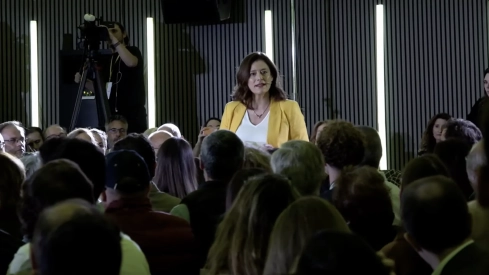
Democracia 21, the new party led by lawyer Miriam González Durántez, held its official presentation this Saturday in Madrid with the Domo 360 space at full capacity, many people viewing it from outside on a large screen and, in addition, thousands of people following the event online. The party thus enters the race for the general elections on November 29, with the aim of bringing its proposal for institutional regeneration and reform of the functioning of the State to Congress.
The event marks the public launch of a political project that was born with a reformist vocation and that has accelerated its plans after the early election announced by Pedro Sánchez on October 5. Although Democracia 21 was registered in the Registry of Parties at the end of June, the call for elections has turned its presentation into the starting point of an electoral race with which it intends to carve out a niche in national politics.
The in-person attendance, with full capacity, and the follow-up through the live broadcast place the party's debut at the center of political attention this Saturday. However, the electoral reach of this call will have to be measured in the coming weeks, as the party specifies its proposals and presents its candidacies.
A commitment to political regeneration
Democracia 21 defines itself as a project aimed at "modernizing Spanish democracy, recovering the integrity of the political system and placing the citizen at the center". Its diagnosis points to structural problems such as clientelism, bureaucracy, corruption and the influence of partisan organizations in institutions.
González Durántez has on different occasions questioned the management of both the PSOE and the PP in terms of democratic regeneration. In her opinion, the politicization of institutions and the lack of profound reforms have contributed to maintaining obstacles that hinder the functioning of the Administration and the response of public powers to social needs.
The new party therefore proposes a critique that goes beyond a specific Government and proposes modifying the operating rules of the political system.
Three main axes: corruption, modernization and well-being
The Democracia 21 program is structured around three main lines of action.
1. A radical political cleansing. The fight against corruption is central to its proposal. The party argues that this phenomenon represents an enormous economic cost for Spain and cites an International Monetary Fund estimate according to which it would be equivalent to 4.5% of GDP, about 60,000 million euros annually. The party uses this figure to emphasize the need to strengthen institutional integrity and combat practices it considers detrimental to the general interest.
2. An Administration adapted to the 21st century. Democracia 21 proposes moving from a State that, in its opinion, accumulates bureaucratic obstacles to one that facilitates the activity of citizens and businesses. Its objectives include reducing administrative procedures, allowing procedures to be resolved in minutes from a mobile phone, and preparing the Spanish economy to compete in an increasingly demanding international environment.
3. Solutions for everyday problems. The party assures that it wants to place at the center of its political action issues such as access to affordable housing, the quality of public services, adaptation to climate change, and the sustainability of the welfare state. Its approach seeks to link institutional reform with concrete results in the daily lives of citizens.
With these priorities, the party aims to present democratic regeneration not only as a matter of political functioning but also as a tool to improve the management of public resources and the provision of services.
From civil society to national politics
Miriam González Durántez, born in Olmedo (Valladolid) in 1968, has developed a good part of her professional career outside Spanish politics. A graduate in Law from the University of Valladolid and trained at the College of Europe in Bruges, she specializes in international trade and European regulation.
Throughout her career, she has worked in community institutions, advised the British Foreign Office, and practiced in international law firms. During the 2021-2022 academic year, she taught international trade policy at Stanford University. She has also participated in business councils and founded Inspiring Girls International, an organization aimed at bringing professional role models closer to girls and young women.
In 2023, she launched España Mejor, a civil society platform conceived to develop public policy proposals without initially constituting itself as a political party. This initiative served as a precedent for the project that now takes shape with Democracia 21 and makes the leap to electoral competition.
Her profile combines legal and international experience with a trajectory linked to citizen participation initiatives, a combination that the new formation places as part of its identity.
Who is Miriam González?
González Durántez's figure has also been linked for years to that of British politician Nick Clegg, former Deputy Prime Minister of the United Kingdom and former leader of the Liberal Democrats, with whom she is married. However, the lawyer has developed her own professional career and has indicated that Clegg will not participate in her political project in Spain.
With the presentation of Democracia 21, González begins a new stage that transfers her experience in the professional field and in civil society to the electoral arena.
The challenge of converting the debut into electoral support
The full capacity of the presentation event and the digital follow-up mark the public beginning of Democracia 21, but the challenge for the formation will now be to convert that initial attention into an electoral structure capable of competing on November 29 and defending its proposals before voters.
The campaign will allow verifying the degree of implementation of the party, its ability to translate its program into concrete measures, and the citizen response to its discourse of institutional regeneration.
For now, Democracia 21 places its letter of introduction in three commitments: fighting corruption, simplifying the functioning of the State, and offering answers to problems such as housing, public services, and the sustainability of welfare. With this program, Miriam González Durántez's formation begins its journey in an electoral call that has accelerated its political birth.
