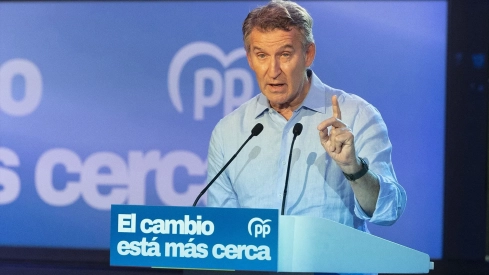
The Popular Party has reacted this Thursday to the ruling of the Court of Justice of the European Union (CJEU), which has endorsed that the Spanish amnesty law does not conflict with community norms. Sources from the party have begun their response by distancing themselves from the attitude they attribute to the Government regarding judicial decisions. "Our absolute respect for the Court's ruling. The PP does not interpret sentences based on whether they like them more or less. Democrats always respect sentences. It would be desirable for the Government to do so in all judicial cases that directly affect them."
Despite this formal support for the resolution, the PP has insisted on delimiting its real scope. According to the same sources, the European ruling "was limited to a very specific analysis" and does not assess either the constitutionality of the norm or its political expediency, but rather resolves "only the specific doubts about certain aspects of Union Law" that the Spanish courts raised. From now on, they recall, it will be those same courts that must apply the law in accordance with what was dictated by Luxembourg.
"The debate was never only legal"
The Popular Party maintains that the CJEU's resolution does not put an end to the controversy over the amnesty law, since, in its opinion, the core of the debate transcends the judicial sphere. "The Government will try to present this ruling as the end of the debate. It is mistaken. The debate was never only legal," they point out from the party.
The popular party maintains that the fundamental question remains whether a Prime Minister can "negotiate criminal privileges in exchange for a parliamentary majority," a practice they reject and consider incompatible with equality among citizens. In this vein, they insist that "no president should exchange power for impunity" and describe as "morally unacceptable" the decision adopted by Pedro Sánchez to push through the law.
The PP also adds that the European court's pronouncement "does not eliminate the political responsibility" of the independence movement for the events that occurred in Catalonia during the sovereignty process. For this reason, it assures that it will continue to defend the model approved in the last congress of the Catalan PP, focused on issues such as access to housing, strengthening healthcare, reducing taxes, and improving security.
