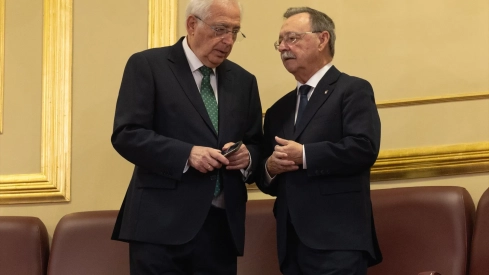
Juan Vivas will travel to Melilla on Monday, November 23 to meet with Juan José Imbroda and sign a collaboration document between the two autonomous governments, a move that the Melilla Presidency presents as an update of the coordination between both cities.
The president of the Autonomous City of Melilla, Juan José Imbroda, announced this meeting to journalists and specified that the visit of his Ceuta counterpart will also include a public event. As he explained, the immediate objective is to review and organize the collaboration commitments that Ceuta and Melilla have maintained for years.
An agreement to align responses to common problems
Imbroda argued that the two cities share “geostrategic and geopolitical problems” and maintained that the responses designed for one of them should have an equivalent reflection in the other. This is the political thesis with which the Melilla president wants to frame the document that will be signed on Monday, although for now he has not detailed concrete measures beyond the update of the joint work framework.
The PP leader also stressed that Ceuta and Melilla must deepen their institutional relations and coordinate their demands before national and European administrations. Among the issues he cited are Morocco's annexationist claims, irregular immigration, and the closure of the commercial customs office, three issues that, according to his approach, require a shared strategy.
Imbroda added that he had already held telephone conversations with Vivas to prepare for this meeting and that the visit will now materialize with a working meeting that he considers “of special importance” for the two Spanish cities.
Brussels, shared representation and the political reading of the trip
The Melilla president also placed this agreement in the context of Ceuta and Melilla's presence in the European Committee of the Regions. He explained that the planned system contemplates a distribution and alternation of representation for a period of four years, with two-year turns for each of the cities.
At that point, Imbroda attributed a relevant role to the president of Castilla-La Mancha, Emiliano García-Page, and to the mayor of Jerez, María José García-Pelayo, whom he thanked for having defended that her seat corresponded to Ceuta and Melilla. According to him, the designation is validated by the Committee of Permanent Representatives of the European Union, and Melilla's presence in that body is due to García-Pelayo's resignation in favor of Ceuta.
Imbroda downplayed the efforts of the Minister of Foreign Affairs, José Manuel Albares, by assuring that "he has achieved nothing" in this process, and stressed that Ceutans and Melillans will be represented in that European forum. The president also indicated that he does not rule out traveling to Ceuta later to return the institutional visit, although he left that possibility pending Vivas's agenda, which, he said, has been overwhelmed since the events of July 30 and 31.
Contact