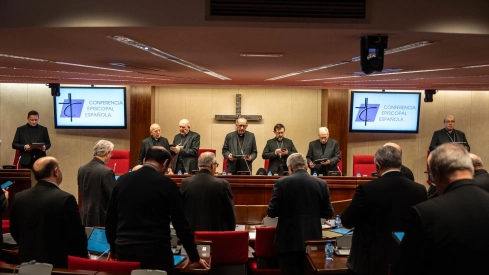
The Conferencia Episcopal Española (CEE) will submit to debate and vote this week a general decree that contemplates new sanctions for clerics involved in sexual abuse crimes against minors. The proposal will be addressed during the CXXIX Asamblea Plenaria.
The announcement has been made by the president of the CEE and archbishop of Valladolid, Luis Argüello, during the inaugural speech of the meeting. In his speech, he stressed that the decree is part of a broader reform process promoted in recent years together with the dioceses and religious congregations, with the coordination of the CEE itself and the Spanish Conference of Religious (CONFER).
Argüello has explained that this previous work has included prevention, training and adaptation measures of the canonical regulations, and has advanced that the new text will seek to reinforce the internal sanctioning regime of the Church. All of this, he has specified, without replacing the criminal procedures that may arise in the civil jurisdiction.
The president of the bishops has also defended the recent agreement reached with the Government for the reparation of victims, recognizing that the abuses constitute "a very serious scandal" that demands a forceful response from a moral and spiritual point of view. However, he has criticized that the Executive has focused its relationship with the Church on this matter and on the resignification of the Valle de Cuelgamuros.
In this regard, Argüello has shown his displeasure for what he considers a lack of recognition for the measures already adopted by the Church in terms of reparation. As he has pointed out, numerous dioceses have promoted processes of listening, restorative justice and compensation to victims without the need for judicial or governmental imposition.
Likewise, it has rejected the statements of the Minister of the Presidency, Félix Bolaños, about the agreement, in which he affirmed that “the Government decides and the Church pays”, defending that the ecclesiastical institution has acted proactively in many cases. In its view, reducing the reparation to an exclusively economic matter implies an incomplete vision of the problem.
Add ElConstitucional.es as a preferred Google source for free.
Stay informed about all the latest breaking news with the best information. Against disinformation, for democracy and social rights.
