The death of Maricarmen Abascal, the 87-year-old woman whose eviction from the home where she had lived for seven decades triggered a wave of protests over access to housing, has once again placed the housing crisis at the center of the political agenda. Her death, which occurred this Wednesday after being hospitalized following the eviction on September 23, has prompted messages of condolence from major political leaders and new calls to strengthen protection measures for vulnerable people.
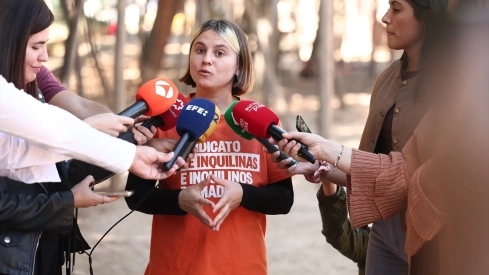
For this reason, the Tenants' Union has called for a minute of silence tomorrow at 12:00 p.m. in all workplaces and study centers in memory of Maricarmen. The organization's spokesperson has claimed what she considers her "last lesson" and has defined the deceased as a "beacon in the fight for housing." "Rentism kills," she stated, before recalling other cases that, in her opinion, show the consequences of the housing crisis, such as those of Olga and Javier in L'Hospitalet, Patxi in Móstoles, Amparo and Marina in Lavapiés, as well as "thousands of people whose names we will not know."
The case has also caused tension in the Madrid Assembly. The PP refused to hold a minute of silence for Maricarmen, considering that this type of tribute should be reserved for certain cases and that accepting the proposal could contribute to the "political use" of her death. Meanwhile, social organizations maintain their mobilizations and are preparing new actions. The Tenants' Union has even announced a horizon of a general strike for November 11, in the middle of the election campaign.
The PP rejects the minute of silence and the PSOE accuses it of lack of empathy
The PP of Madrid refused to participate in an institutional minute of silence for Maricarmen in the Madrid Assembly and in the capital's City Council, considering that her death was being politically exploited. The popular party defended that they did not want to contribute to an "interested campaign" and demanded that the case not be used to attack the party or the Madrid administrations.
The decision provoked a reaction from PSOE and Más Madrid, whose representatives decided to observe the minute of silence on their own outside the Assembly. The Madrid socialists accused the PP of "lack of humanity and empathy" and criticized that they did not join a gesture of remembrance for the 87-year-old woman. In the Madrid City Council, the confrontation was repeated: PSOE and Más Madrid held their own tribute in front of the Cibeles Palace after the institutional minute of silence did not prosper. The mayor, José Luis Martínez-Almeida, defended his party's position and questioned the opposition's use of the case for political purposes.
The controversy arises while Maricarmen's case continues to generate mobilizations. The Tenants' Union has called for a minute of silence this Friday at 12:00 p.m. in workplaces and study centers throughout the country, while demanding that her case serve to focus on the difficulties of access to housing.
The Government asserts that housing remains at the center of its agenda
The Executive has conveyed its condolences to the family and has defended the need to continue acting to prevent similar situations from recurring. The First Vice President and Minister of Economy, Carlos Cuerpo, has pointed out that Maricarmen's tragedy demonstrates that behind the housing crisis there is "a human drama" and has defended that administrations must continue working to guarantee affordable access to housing.
Cuerpo has also linked the situation with the results of a CIS survey released this Thursday. According to these data, 80% of Spaniards consider housing a right and not an asset, while 76% demand that administrations act to guarantee access to it. The minister has defended that these figures show the social dimension of the problem and the need to continue adopting measures.
The Executive's position comes after emergency measures related to housing were approved in recent weeks, in a context of strong social pressure due to rising rents and difficulty in accessing housing. Maricarmen's death has made her case a symbol of this problem, although the Government has insisted that the objective must be to prevent other vulnerable people from going through similar situations.
Housing returns to the center of the political debate on the eve of 29N
The political dimension of the case has grown as the death coincided with the start of the race towards the general elections. The main parties have expressed their condolences, although differences over the management of the housing crisis have once again been exposed. The President of the Government, Pedro Sánchez, expressed his sorrow for Maricarmen's death and conveyed his support to her family and loved ones. The Government has argued that the situation should serve to reinforce policies aimed at guaranteeing access to affordable housing.
Todo mi cariño a la familia y a los seres queridos de Maricarmen.
— Pedro Sánchez (@sanchezcastejon) October 7, 2026
Un abrazo también a todos los que hoy sentimos esta pérdida como propia.
Descanse en paz.
The death of Maricarmen thus leaves open a debate that transcends her personal case: how to guarantee access to decent housing and what responsibility falls to administrations in the face of a crisis that especially affects households with fewer resources. With the elections on November 29 already called, housing will once again occupy a central place in the confrontation between parties.
