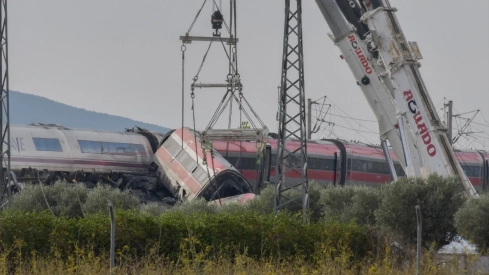
The Institute of Legal Medicine and Forensic Sciences of Toledo and Ciudad Real has identified the 69 people who died in the train accident that occurred last Wednesday in Urda (Toledo), according to data provided Monday night by the Integrated Data Center (CID).
According to the provisional balance released by the High Court of Justice of Castilla-La Mancha, among the victims there are 54 people of Spanish nationality and 15 foreign citizens, all of them adults. The official count places the deceased at 40 men and 29 women.
Identification of victims and communication to families
The CID reported that the 69 identifications have already been notified to the victims' families and, in the case of deceased foreign nationals, also to the corresponding consular offices. The organization emphasizes that the identification and communication to next of kin were carried out with the greatest possible rigor and speed.
According to the statement, the procedure established that, once the identity of a deceased person was confirmed, personal and in-person notification was first made to the family, and only after that reliable notice was the data incorporated into the official statistics publicly disseminated by the Data Integration Center.
At this moment, the provisional balance remains at 69 deceased persons, within the framework of the protocol activated after the accident and established based on the National Protocol for Medical-Forensic and Scientific Police Action in Mass Casualty Incidents.
Fingerprint and DNA tests
Of the 69 identifications, 56 were carried out by fingerprint, with the intervention of the Civil Guard's Criminalistics Service, while the other 13 were carried out through DNA analysis, performed by the National Institute of Toxicology in collaboration with the Civil Guard's Criminalistics Service.
Among the foreign victims are 4 US citizens, 2 Australians, 2 Japanese, as well as 1 Argentinian, 1 Canadian, 1 Czech, 1 French, 1 Mexican, 1 Portuguese, and 1 Tunisian.
The CID added that 55 deceased persons are already at the disposal of their families, while administrative and forensic actions related to the closure of the identification process continue.
More than 60 professionals in forensic work
More than 60 professionals participated in Toledo since last Wednesday in autopsy and identification tasks. Among them are forensic doctors from the Institutes of Legal Medicine and Forensic Sciences of Toledo (12), Ciudad Real (4), Cáceres (2), and Cuenca (1), as well as 2 advisory forensic doctors from the Ministry of the Presidency, Justice and Relations with the Cortes.
8 autopsy technicians also participated in the autopsies, specifically 3 from Toledo, 2 from Albacete, 2 from Cáceres, and 1 from Guadalajara. In addition, 9 professionals from the National Institute of Toxicology, responsible for post-mortem DNA tests, joined them.
Likewise, 27 Civil Guard agents, belonging to the Criminalistics Service and the Judicial Police, participated in identifications by fingerprint, in addition to DNA analysis of relatives who reported disappearances.
Psychological support and UME logistics
The CID also indicated that a support service for the victims' families was set up, comprising 3 psychologists from the Institute of Legal Medicine and Forensic Sciences of Toledo and 1 psychologist from the Institute of Legal Medicine and Forensic Sciences of State Jurisdiction Bodies.
For its part, the Military Emergency Unit (UME) provided logistical support until the completion of identifications and notifications, with means and capabilities aimed at facilitating the management of the deceased and the development of identification and medical-forensic assistance tasks.