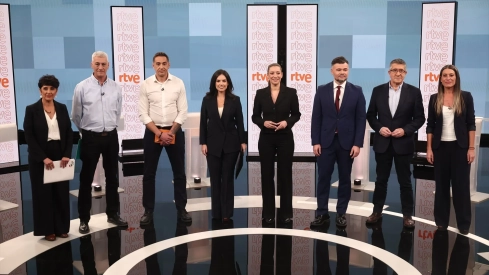
Housing, pensions, and reproaches between parties have marked the start of the RTVE eight-party debate, moderated by Xabier Fortes six days before the general elections on November 29. The spokespersons have confronted their proposals amidst interruptions, accusations about their pacts, and clashes also between the Catalan independence forces. Who convinced you the most? Vote in the ElConstitucional.es poll.
Gabriel Rufián (ERC) and Míriam Nogueras (Junts) starred in one of the most tense exchanges of the first block. Rufián defended intervening in the housing market and increasing tax pressure on those who accumulate properties for speculation. Nogueras reproached him for his support of the Government and claimed that Catalonia's resources should be used to improve its hospitals, housing, and opportunities for young people. She also defended amnesty as a result of her party's negotiation.
In the housing and welfare state block, Patxi López (PSOE) advocated for the construction of public housing that retains that condition and the regulation of rents, while reproaching PP, Vox, and Junts for their votes against Executive measures. Emilio Delgado (Frente Amplio) defended combining public construction, regulation, and an investment equivalent to 1% of GDP. Oskar Matute (EH Bildu) pointed to speculation as the cause of difficulties in accessing a home and demanded rules that guarantee stability.
Ester Muñoz (PP) directed her attacks at the Government and left-wing forces, with reproaches on housing, equality, and sexual violence. She defended building more, lowering taxes, and toughening the response to occupation. Pepa Millán, from the far-right Vox, brought the Ceuta crisis and her anti-immigration discourse to the debate on public services. Maribel Vaquero (PNV) called for agreements to regulate and build housing and clashed with Muñoz when claiming her party's role in the revaluation of pensions during the Rajoy Government.
Contact
We are listening. Get in touch.
