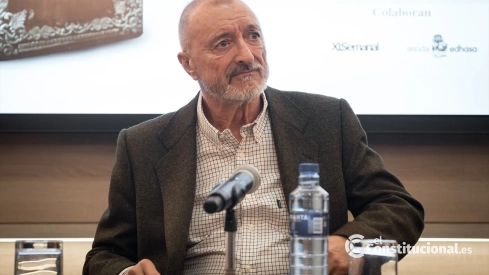
Writer and academic Arturo Pérez-Reverte has launched a harsh criticism against the Royal Spanish Academy (RAE) and its director, Santiago Muñoz Machado, accusing them of having yielded to external pressures and of having renounced firmly exercising their normative function over the language.
The criticisms are collected in an opinion piece published in El Mundo under the title “Why it neither fixes, nor cleans, nor gives splendor”, in which Pérez-Reverte maintains that the RAE has gone from setting clear linguistic criteria to uncritically adapting to media usage and trends, even when these contradict traditional norms.
Gossip
The writer denounces that within the institution, what he calls "the Taliban of anything goes" has been imposed, a current that, according to him, accepts any use of language with the argument that "if it is used, it is valid," thus weakening academic authority. In his opinion, this approach turns the RAE into a mere observer of the language, rather than a reference that orders and cares for it.
Pérez-Reverte also criticizes that many linguistic decisions are made due to social, media, or political pressure, and not after rigorous technical debates among specialists. In this regard, he laments that the Academy acts out of fear of being labeled elitist or exclusionary, which, he claims, ultimately gives more weight to pundits, influencers, or poorly written headlines than to philological criteria.
Pérez-Reverte's criticisms of the RAE are not new and are part of a specific line of thought that the writer has repeatedly expressed in recent years through his social media. The writer has often shown his rejection of what he considers an 'excessive relaxation of linguistic norms', especially in debates about spelling, inclusive language, and the acceptance of uses from social media and the press. Through articles, interviews, and social media posts, Pérez-Reverte has argued that the Academy must set clear limits and exercise authority, even when its decisions are unpopular.