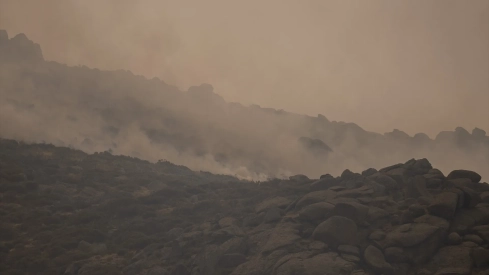
Wildfires have already burned 208,286 hectares in Spain from the beginning of the year until this Monday, July 27, according to the latest update from the European Forest Fire Information System (EFFIS). The affected area exceeds the average recorded during the last 20 years at this point in the season and reflects the magnitude of a wave that maintains several active fronts in Ávila, Madrid, and Castellón.
The EFFIS figure comes from images collected by European satellites and offers an almost real-time estimate. Its methodology counts fires that exceed 30 hectares and usually yields higher balances than those of Ecological Transition, which are prepared from reports submitted by autonomous communities and consolidated with greater delay.
The latest provisional data released this Monday by the Ministry places the burned area at 172,396.10 hectares, almost six times the 29,817 recorded during the same period in 2025. Ecological Transition also counts 35 large wildfires, those exceeding 500 hectares, compared to eleven a year ago. The difference between both balances responds to their different measurement systems and update times.
The emergency continues to be concentrated in the peninsular center. Burgohondo is around 50,000 hectares, the fire in the Sierra Oeste de Madrid reaches approximately 28,000, and the fires in Ávila, Madrid, and Toledo have forced the evacuation or confinement of more than 90,000 people. The emergency of national interest declared on Friday keeps the Ministry of Interior in charge of coordinating operations.
Burgohondo maintains two active zones after burning 50,000 hectares
The fire that started last Wednesday in Burgohondo has become the largest documented in Spain since the current historical series began. The fire has affected about 50,000 hectares and its perimeter extends for about 160 kilometers through the Alberche Valley and the Tiétar Valley, with numerous municipalities evacuated or confined.
The evolution has improved in recent hours, although the teams maintain their attention on two active zones in the Mijares pass and in the vicinity of Casillas. In Mijares, the personnel managed to contain a reproduction next to a forest track during the early morning. Casillas remains evacuated while work is underway to protect the urban core.
The technical director of the operation, Alejandro Peñalvo, has explained that the change in wind direction to the south may favor extinction efforts and prevent a new expansion of the perimeter. Embers and internal reproductions continue to force continuous review of areas that seemed secured, especially in the most abrupt areas of the sierra.
Close to 3,000 professionals and around a thousand ground, air, and support resources are participating in the coordinated response to the fires in Ávila and Madrid. Fernando Grande-Marlaska has assured that there is "control over the emergency," although he has acknowledged that the teams are advancing "slowly" due to meteorological conditions.
The Minister of Interior believes that this Monday and Tuesday will be "absolutely central" days to consolidate the perimeters. The arrival of a new heatwave starting Wednesday threatens to raise temperatures again, reduce humidity, and favor possible reactivations.
Madrid reaches 28,000 hectares and evacuates Valdemaqueda
The Community of Madrid has raised the affected hectares by the Sierra Oeste fire to about 28,000, according to its official update at 4:00 p.m. The three fires that started in Villa del Prado, San Martín de Valdeiglesias, and Almorox ended up merging last Friday into a single fire, which remains active and has three fronts.
The work is mainly concentrated to the north of the San Juan reservoir, in the vicinity of San Martín de Valdeiglesias and next to the Cofio river. The flames from Ávila have re-entered Madrid territory and have forced the evacuation of Valdemaqueda, one of the points that until now remained confined.
More than 55,000 people remain evacuated or confined in the region and around 2,500 remain in the 18 enabled reception points. San Martín de Valdeiglesias, Pelayos de la Presa, and Villa del Prado remain confined, while restrictions affect numerous municipalities and urbanizations in the Sierra Oeste.
"It's a hellish situation," Isabel Díaz Ayuso has acknowledged from the advanced command post in Navalcarnero. The Madrid president has placed the greatest concern on the western flank and in the vicinity of the San Juan reservoir, where teams are working to prevent the flames from reaching new homes.
Operational situation 3 of the INFOMA Plan remains activated throughout the Community of Madrid. During the afternoon, 34 ground and air fire and forest fire brigades are working in the area, along with 40 forest agents and resources provided by the State and other administrations.
Castellón exceeds 7,000 hectares before the new heatwave
The La Vall d'Uixó fire has already burned some 7,200 hectares and reaches a perimeter close to 67 kilometers. The flames have penetrated the Sierra de Espadán Natural Park and have affected twelve municipalities integrated within one of the main forest areas of the Valencian Community.
Around 16,000 people remain evacuated and another 65,000 continue confined in different towns in the south of Castellón. More than 400 ground personnel and 25 aerial assets are working mainly in Eslida, the Montserrat urbanization of Betxí and the Montí area, in Onda.
Pedro Sánchez visited the advanced command post this Monday and warned that there are still "difficult and complex hours" ahead. The Council of Ministers will declare the affected territories as areas seriously damaged by a Civil Protection emergency this Tuesday, which will allow the activation of state aid for homes, businesses, agricultural exploitations and infrastructures.
In Guadalajara, the La Mierla fire is in the stabilization phase after having affected between 32,000 and 35,000 hectares, depending on the measurement used. The fire has become the largest recorded in Castilla-La Mancha and has devastated a considerable part of the Sierra Norte Natural Park. Selas, also in Guadalajara, has been extinguished after burning around 2,800 hectares.
AEMET has activated a special warning for the fourth heatwave of the summer, expected from this Wednesday until at least Sunday. The risk of fire will increase to extreme values due to high temperatures, south wind and low humidity. Extinction teams are working against the clock to secure the perimeters before thermometers exceed 40 degrees again.
