
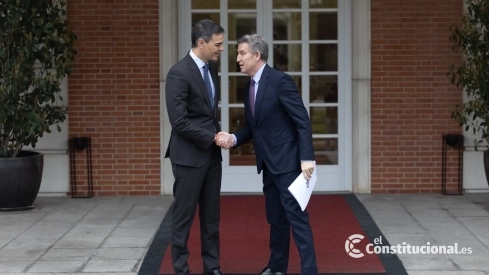
Political polarization is, by definition, **the fragmentation of society into two opposing ideological blocs**. It can be said that we live in a divided world, and according to a 2025 study by the organization *More In Common*, **Spain is becoming increasingly polarized with the years.** This polarization, added to the current political tension, has led to dialogue, consensus, and respect for differing opinions being conceived as concepts of the pastPoliticians, with their constant insults and attacks in parliament, intense television debates with the occasional shout, disinformation, and hate speech spread through social media, among other factors, widen the rift between the two ideological "camps." **This brings many consequences, such as the breakdown of family and friendship relationships, the radicalization of disgruntled citizens, and, of course, the great deterioration it causes to democracy.** When our political representatives treat their political adversaries as enemies, and disqualification prevails over argument, civil society begins to divide into "them" and "us," **or, to put it another way, the "bad guys" and the "good guys."** Currently, on a first date, many people would get up from the table if they discovered that the person in front of them holds a different ideology than their own.
50 years ago, we fought to end that normalized and institutionalized division between "reds" and "blues," and we achieved a situation where all Spaniards could express their opinions without fear of being attacked; instead, today expressing an opinion can sometimes be a risky sport. If the Francoist ex-minister Manuel Fraga was capable of drafting the Constitution and reaching agreements with the Catalan regionalist Miquel Roca and the communist Jordi Solé Tura, it cannot be that we are incapable of debating with someone without using terms like "fascist," "red," "fascist," or "hippie." The term "fascist" has almost lost all its harshness. Yes, anyone who questions the ideas of the current left is a "fascist," with all that adjective entails. If not, we won't know how to distinguish the real fascist from the one who isn't. Hearing this term should put us on edge, as it signifies violence, authoritarianism, decay, and suffering. If we hear it more than we should, we would stop knowing against whom and whom we should fight. And that precisely benefits the authentic fascists.
Heated and polarized societies are characterized, among many other features, by their lack of arguments in their debates; therefore, and in the absence of reasoning, derogatory terms emerge. When some people run out of arguments, they have to resort to them. Other people, who although they have valid arguments, prefer to resort to them. Their use is very simple: if you defend a position commonly recognized by the right, you are a "fascist," and, conversely, if your argument is associated with the left, you are a "commie." It is not necessary for you to be either left-wing or right-wing; the objective is not to refute, but to discredit the other interlocutor.
A SUMAR voter who believes that the amnesty for Puigdemont and the other Catalan pro-independence leaders involved is negative and unjust could be labeled a "fascist." And a PP voter who thinks that reducing the working day is fair and necessary could be called a "communist." It is curious to observe that a person can be a "fascist" and a "communist" at the same time; in fact, I would dare to say that almost all of us can be "fascists" and "communists." Because the majority of people have ideas associated with the left and with the right, and a mixture of both.
Finally, if we want a society of respect, dialogue, and consensus, we must start by demanding more respect and example from our political representatives, calmer and less heated debates from television media, and as a society, we must listen more calmly to opposing opinions and know how to debate them with tolerance. We must also verify all information that reaches us, especially if it comes from social media, and not share articles or news whose veracity we doubt. But for this, from civil society we must engage in self-criticism, and if we truly want change and a united society, we must all do our part regardless of our ideology.
