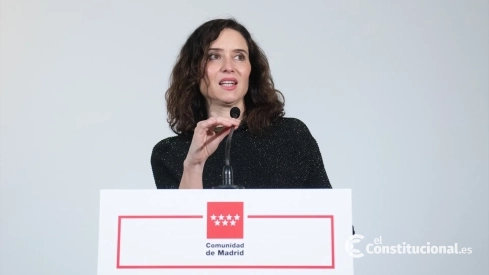
Isabel Díaz Ayuso, president of the Community of Madrid on a part-time basis (perhaps in the ephemeral lulls that her agitator and disturbing mood allow her), has decided that the mourning for the victims of the Alvia train would not remain static in Huelva, taking advantage of loopholes created by others' haste, and through which the self-proclaimed Madrid Marianne of the libertarian, in the style of the most radical far-right, that Ayuso who before being president was an influencer under the now-worn name of “Pecas,” could infiltrate.
The Government of Spain and the Regional Government of Andalusia have announced a "State Tribute" on Saturday the 31st in Huelva, the hometown of most of the deceased and injured in last Sunday's fatal train accident, and it didn't take long for Ayuso to make a move. A move not for consolation, but for prominence: a funeral mass at the Almudena Cathedral, on Thursday the 29th, in Madrid. This is not an isolated gesture. It is another move by the character with the acquiescence of the Archdiocese of Madrid.
The detail that turns the maneuver into something more than a pious act is the timing. That same Thursday the 29th, there is also a funeral mass in Huelva, called by the Provincial Diocese. Two cities, two altars, one same mourning. And, above all, the institutional act on the 31st. In politics, this is not simultaneity: it is a dispute over framing. Because the pain is the same, the scene is not. Up to here, the visible board.
Now, the key that explains why this board exists. After the accident, Pedro Sánchez and Moreno Bonilla decided to announce the tribute agreement as too many things are announced today: leaking through the social network Twitter (screw you, Elon, it will always be Twitter) that there had been a phone call, agreeing on the narrative of "we've talked about it" and taking it to their social media as if that were enough to close the matter. The appropriateness of the tribute is not being discussed. The method is being discussed: hastily announcing a State act —a State act— as if the State were the timeline.
In parallel, part of the public conversation has followed suit: "Will the King and Queen come?". As if the tragedy were ordered according to the guest. As if the main thing were not the victims, but the photo of the representation. Several media outlets have taken their presence for granted. But the relevant channel, the only one that turns expectation into confirmation, the Royal Household, had not yet confirmed it - and in fact, still hasn't - and the media outlets that have stated "according to sources from Zarzuela", are simply lying. What's more, the websites of La Moncloa and the Junta de Andalucía have not yet included the State Tribute on January 31st in Huelva in their respective agendas. The only "official" sources, scarce in details, are two tweets from Sánchez and Moreno Bonilla. There is nothing else.
The Royal Household's public agenda is published according to its own mechanism and timeline. This editorial team has had several conversations this week with press officers from the Household of H.M. the King. There was nothing that required quotation marks, and a phrase is not forced where there isn't one. There was procedure. There was institutional pedagogy. And above all, there was that characteristic diplomacy of Zarzuela: the kind that doesn't need to say "no" to make it clear that things aren't done by shoving.
From there, what follows is no longer information, but reading. But reading with foundation, because it stems from how one responds when responding. The inference of the undersigned — and which is offered as an inference, not as "data" — is that Sánchez and Moreno Bonilla's haste to announce the tribute as if the board were already closed has left a window open. A small window, but sufficient. Because when political announcement runs ahead of the institutional track, a gap is created: a space of expectations before protocol writes what corresponds in its place. And that gap is always exploited by the same type of actor: one who lives by turning a void into pressure.
And there are the considerable aspects of what we are talking about when we talk about Ayuso.
My hypothesis —and I’m not selling it as anything else— is that Ayuso is playing with a stacked deck. She doesn’t need to say “come” or “don’t come.” She doesn’t even need to name anyone. It’s enough for her to activate a known mechanism: turning a national event into a conflict of centrality. Huelva organizes, the State convenes, Madrid bursts in. And, with Madrid, the studio, the talk show, the carousel of headlines, and the inertia that the important things always happen where there are more cameras, all burst in.
That's why this story isn't about a mass. It's about who positions themselves at the center of the country when the country is in mourning. And, in that game, Ayuso is a specialist: appearing where she hasn't been called so it seems like the country isn't complete without her. The "dead woman at the funeral" isn't an easy description; it's a portrait of a method. Faced with a tragedy that belongs to the victims and their families, the country's most cynical politician competes for the frame and the photo.
And it does so with a more dangerous ingredient than incense: language. Where others speak of a State tribute, Ayuso and her mouthpieces slip in the term "State funeral" for her event at La Almudena. The Huelva event, even with royal presence, has been called a "State tribute." This is not a nuance. A *funeral* implies maximum solemnity, liturgy, unavoidable imagery, and symbolic and ecclesiastical hierarchy. "Funeral" places whoever convenes it—or claims it— at the center of the grieving nation. A *tribute*, on the other hand, is a civil way of saying that this, the grief, belongs to everyone. Precisely for that reason, no one should appropriate it
The challenge, then, is not just Madrid. It's a change of label. It's an attempt to make the country repeat a word that raises the bar for presence, representation, protocol, and expectation. It's a way of pushing the agenda of others without touching it: it's not dictated, it's circumvented. A climate is created. The noise is allowed to do the dirty work.
Here, inevitably, comes the craft of Miguel Ángel Rodríguez, Ayuso's chief of staff, an old fox of politics who has always understood one thing: that the most effective pressure is not formulated as an order, but as a narrative. There is no need for anyone to "ask" for a specific presence. It is enough to open the alternative scenario, raise the solemnity, and let the headlines ask the question for you. **The script is transparent: if the mourning is a State affair and Madrid sets up an altar, the public discussion stops being "what happened" and becomes "who will be where." And that is the victory, however obscene: to shift the center of pain to the center of the camera.**If this were just an institutional discussion, it would be ugly. But it's worse: the victims are once again trapped in a power struggle. What should be memory and respect becomes a board where Ayuso moves pieces to get in a photo where no one expects her. And the country, which should be supporting those who have lost their loved ones, ends up consuming the tragedy as if it were just another episode of the culture war and media battleWho is willing to use a collective duel to consolidate leadership through an agenda? Because when the goal is to occupy the center, the pain of others ceases to be a limit and becomes a resourceWhen "the State" announces with the haste of a community manager, without properly attending to protocol, cracks open in the institutional lane. Noise enters through the cracks. And with the noise, someone always appears ready to turn everything—even mourning—into an opportunity. This is the politics that Isabel Díaz Ayuso represents better than anyone. And that, in such a tragedy, should not be tolerable, neither out of decency nor out of respect for those who can no longer defend themselves: the victims, once again turned into a backdropPS.- Feijoo, cowardly, fainthearted, loudmouth, is planning how to clone himself so that, without offending by absence or presence, he can be at two masses at once on January 29... and not be crazy