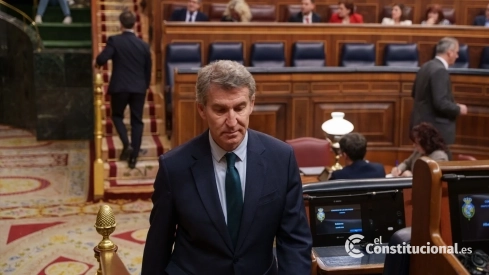
What is happening between the Partido Popular and Vox in Extremadura and Aragón is not just a tug-of-war between two parties of the parliamentary spectrum. It is a symptom, and it is a quite revealing symptom. Look, Génova has decided to take direct control of the negotiations with Vox; that is, what until now was presented as territorial autonomy of the barons is now supervised from Madrid. And here is the first key, because the one who centralizes today is the same one who, when he presided over the Xunta de Galicia, defended just the opposite. Alberto Núñez Feijóo built his leadership by claiming autonomy against the national leadership of the Partido Popular. Ask Soraya Sáenz de Santamaría. Galicia was not directed from Madrid, he said. Galicia decided for itself. Today, however, the one who decides is Génova 13. Change of criteria? Well, not exactly. It is a change of context. And it is probably also a clear symptom of weakness.
Feijóo promised, when he arrived at the presidency of the PP, a more choral, more territorial, less presidentialist model. But the negotiation with Vox becomes complicated as soon as there is a real risk of blockage. It is then when the national leadership intervenes. Why?, you will ask yourselves. Because the Popular Party does not have a clear strategy against Vox. That seems more than evident and that is what we are seeing. For months the discourse was: “We are not the same”. Afterwards it was: “We will talk if necessary”. Later: specific agreements. Now: framework document, written conditions and direct supervision from Madrid. It is a sequence that transmits one thing: improvisation.
And, meanwhile, Vox plays a different game: public pressure, grievance, the staging of conflict. It knows that the Popular Party needs its votes and tensions the rope to the limit. The result is paradoxical: the more the Popular Party tries to set rules, the more it evidences its dependence.
But there is something, if you press me, even deeper. When a leader who built his political profile on territorial autonomy decides to recentralize strategic decisions, what he is doing is not just coordinating: he is sending an internal message. Two points: “I don't trust that this will turn out well if I don't control it”. And that says a lot about the moment Alberto Núñez Feijóo is going through. He does not find a solid discourse against the far-right. He doesn't quite decide if the strategy is to compete with Vox in some frameworks —such as immigration, the climate agenda, gender violence, or national identity— or to draw a clear line. And when a party doesn't know whether to differentiate itself or to resemble, it ends up moving in an absolutely unstable terrain.
The problem is not just arithmetic, it is strategic. If it agrees too much, it normalizes. If it marks too much distance, it blocks governments. If it oversees from Madrid, it contradicts its own narrative. If it leaves total freedom, it risks territorial incoherence. It is the perfect swamp.
And the most delicate thing is that this situation is not conjunctural. It's not just Extremadura or Aragon. It's a structural dilemma of the Spanish right. Feijóo arrived promising stability and moderation. Today he projects permanent crisis management. And in politics, perception matters as much as numbers.
The question is no longer whether there will be an agreement with Vox. The question is what strategic price the Popular Party is willing to pay for not having defined earlier what relationship it wants to have with the far-right. Because, when one, making good on that phrase by Groucho Marx, changes principles according to the circumstance, one stops seeming strategic and starts seeming reactive. And that, for a national leader who aspires to govern Spain, is a problem.
Add ElConstitucional.es as a preferred Google source for free.
Stay informed about all the latest breaking news with the best information. Against disinformation, for democracy and social rights.