
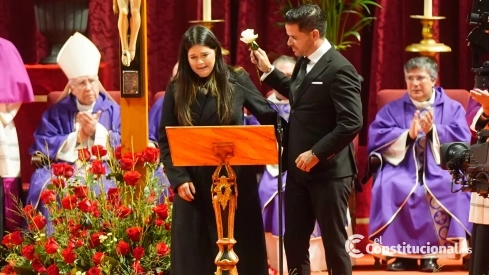
Today, silence weighs heavier than words. The Carolina Marín Sports Palace transforms into **a space of shared mourning, into the staging of the collective suffering** of a country struck by **tragedy**. It is not a place for grand speeches or gestures, but for **containment, respect, and presence.** Where there is normally noise and celebration, today only contemplation is fitting in the face of a loss that challenges us all.
A railway accident of such devastating magnitude —with 45 people dead and hundreds injured— cannot and must not be treated as just another piece of news in the breakneck succession of headlines. It is not an incident; it is a wound. And like any deep wound, it demands time, respect, and a moral pause. As a society, we cannot look the other way or take refuge in the comfort of accelerated forgetting. Nor can we afford the temptation to turn grief into noise.
Today is the time for the victims. For their names, for their cut-short lives, for the projects that will never be fulfilled. It is the time for the families who are waiting, for those who already know, for those who cannot yet grasp the magnitude of their loss. Accompanying is not just being physically present; it is also remaining silent when appropriate, renouncing the rush to explain, avoiding the need to immediately offer an opinion on what still hurts too much.
It is true —and it would be naive to deny it— that perhaps there are things that could have been done better. **Every tragedy of this magnitude inevitably raises uncomfortable questions**: about infrastructure, protocols, technical decisions, or administrative responsibilities. **But today is not when they should take center stage**. The urgency of **analysis** cannot override the dignity of mourning. Before reports and hearings, there is human support. Before diagnoses, **empathy**.
We live in times when public debate seems incapable of stopping, even in the face of death. Everything is measured in terms of opportunity, media impact, or political profitability. That is why it is essential to advocate, even for a moment, for an ethical truce. Political calculations are in excess now, media campaigns designed with decisive regional elections in mind, and, of course, the self-interested disinformation of some. Not everything goes when there are broken lives involved.
Collective pain does not admit flags or slogans. It does not understand blocks or ideological trenches. Whoever enters the Carolina Marín Sports Palace today does so not as a voter, activist, or spectator: they enter as a vulnerable citizen, aware that tragedy could have touched them closely. That shared awareness is what should guide us in the coming hours and days.
Huelva thus becomes the epicenter of pain, but also a mirror. In its solemnity, an entire society confronted with its fragility is reflected. The image of a packed venue, not to celebrate a victory, but to mourn a loss, reminds us that what is common is not always joy; sometimes, what is common is grief. And recognizing it makes us, paradoxically, stronger as a community.
This is not about renouncing the truth or indefinitely postponing responsibilities. It is about ordering the times. About understanding that there is a time for comfort and another for accountability. Confusing them only adds suffering to suffering. The rush to point fingers can end up erasing the victims from the center of the narrative, and that would be a second injustice.
In these times, it is also worth reflecting on the role of the media. Informing is a democratic obligation, but doing so with respect is an ethical responsibility. Repeated images, morbid details, speculation without verified data do not bring clarity; they only erode trust and amplify pain. Faced with information overload, perhaps the most honest gesture is sobriety.
Huelva, today, asks us for that: **sobriety, respect, humanity**. It asks us to face the tragedy head-on without turning it into a spectacle. To accompany those who suffer without appropriating their pain. To remember that **behind every number there is a concrete life**, a face, an irreversible absence.
When time passes —because it will pass, even if it seems impossible now— the time for answers will come. The hour will come to demand explanations, to improve what has failed, to learn so that something like this never happens again. But not today. Today is the day for shared silence, for discreet embraces, for respectful memory.
Huelva does not want to be the protagonist of tragedy, but it is. And in that involuntary protagonism, it challenges us all. It reminds us that the true measure of a society is not only observed in its celebrations, but, above all, in how it supports its victims. Today, more than ever, rising to the occasion means knowing when to stop.
I want to highlight, to conclude, the heartfelt words of Liliana, a relative of one of the victims, who spoke not from slogans or immediate accusations, but from an open wound. "What we lost that fateful Sunday was not just a number," she said, recalling that those 45 were not a number, but parents, mothers, children, interrupted projects, and affections. By stating that "we are the 45 families whose clocks stopped," she gave exact words to what this entire country sensed without knowing how to express: that the time for mourning does not coincide with the time for public debate. Her intervention, marked by gratitude, pain, and a serene demand for truth, returned the narrative to its rightful place: that of the victims at the center, without noise, without haste, and without instrumentalization.
