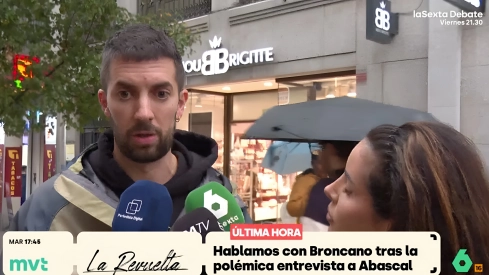
David Broncano has sung the mea culpa. A day after receiving Santiago Abascal on 'La Revuelta', the presenter admitted that he was not satisfied with the interview and that he regrets how he approached a conversation that ended up straying from the usual tone of the program. "I'm sad, yes, because I think I didn't do well yesterday," he admitted to journalists this Tuesday.
The host of the La 1 show did not hide his discomfort and explained that for a good part of the encounter he was aware that he was not responding as he would have liked. "I was wrong with several things about how it was done," he assured, before admitting that he probably should have resorted more to comedy, one of the hallmarks of the format. Broncano explained that he had received recommendations to avoid jokes with political representatives and that this caution ended up conditioning his way of interviewing Abascal. A decision that he now considers wrong. The presenter also denied that the change of tone was imposed by Moncloa and personally assumed responsibility for the result.
But his statements went further. Broncano admitted that he felt uncomfortable with himself when he realized that the atmosphere of the theater was completely conditioned by the audience's reaction. As he explained, he even thought during the conversation that he had made a mistake and that he was not being able to refute the Vox leader with the necessary speed.
Broncano admits that Abascal won the game with the audience and acknowledges that he felt overwhelmed
One of the aspects that weighed most heavily on the presenter's subsequent assessment was the decision to allow Vox to bring its own attendees to the theater. Abascal attended 'La Revuelta' amidst shouts of "president, president," a scene that surprised the team and, as Broncano admitted, completely conditioned the development of the interview.
The host has admitted that Abascal's party played its cards well and that the audience selection was a strategic decision. Broncano explained that he accepted this condition because he thought it would prevent Vox from using a possible negative reaction from regular viewers as an argument to present itself as a victim. However, the result was just the opposite of what he expected. "Abascal did well," he acknowledged about the party's strategy. The comedian described a situation he considered unequal: while the Vox leader's interventions received applause, his own responses were met with murmurs. In his opinion, this difference made it especially difficult to maintain a balanced conversation.
The host also wanted to clarify that he had not requested to be in charge of political interviews. He defined the situation as a difficult task derived from working on public television and on one of RTVE's most-watched programs. Although he believes that Vox's presence on the show is justified by its parliamentary representation, he admitted that he did not know how to manage the encounter appropriately. The interview also left several moments of tension. Abascal called Pedro Sánchez a "dictator," a statement for which Broncano reproached him that such accusations contribute to increasing polarization. The Vox leader also defended his discourse on immigration, questioned climate policies, and maintained that men are criminalized when talking about gender violence.
Another of the most commented exchanges came at the end of the program. When only a few seconds were left, Broncano said goodbye by telling him that he was not going to wish him luck. Abascal replied: "I wish you luck because you're going to need it", because he was going to need it. A jab that quickly became one of the most commented moments of the night.
Abascal's visit, Vox's conditions, and a political storm that splashes RTVE
The controversy is not limited to the outcome of the interview. Abascal's presence on the program has also focused on the prior negotiations and the conditions that Vox demanded to appear on set. According to information published by 'El País', RTVE had sent invitations to the main political parties to participate in different spaces on the channel during the election campaign. However, Vox did not initially accept the proposals. The situation changed after Pedro Sánchez visited 'La Revuelta' and the program registered a historic audience: a 33.9% screen share and an average of 4,387,000 viewers. It was then that Abascal's party agreed to attend, although only to Broncano's space.
During the conversations, Vox asked to bring its own audience because it considered that the program's regular viewers were too hostile. It even proposed a formula in which half of the attendees would be regulars and the other half would be selected by the party. Finally, RTVE accepted that the party would choose the viewers who would be present in the theater. The network justified the decision for security reasons and to prevent Vox from using a possible public rejection to victimize itself. The president of RTVE, José Pablo López, defended that they did not want to give arguments to those who could accuse public television of censorship. However, the News Council harshly criticized the result and described both the change of audience and the abandonment of humor and entertainment that characterize the format as serious errors.
Muchos diréis que bastaba con decirles que no. Pero en RTVE no regalamos excusas a nadie para gritar censura ni creamos mártires en un teatro.
— José Pablo López (@Josepablo_ls) November 10, 2026
Seguramente no fue el escenario ideal para el talento de David, y nos invita a la reflexión, pero es fácil ser "capitán a posteriori".… pic.twitter.com/RxZ9AOetBA
The political reaction was also swift. Pedro Sánchez condemned Abascal's words directed at the presenter and assured that "threatening with a smile is not making humor". The government spokesperson, Elma Saiz, also censored what happened and pointed out that during the interview a politician was seen insulting a worker. Gabriel Rufián, for his part, defended Broncano despite considering that he did not achieve the expected result. The ERC leader asked that he not be lynched and recalled the difficulty of confronting Abascal's positions. Irene Montero also came to his defense and questioned that all responsibility fell on the presenter.
Amenazar sonriendo no es hacer humor, es degradar nuestra democracia.
— Pedro Sánchez (@sanchezcastejon) November 10, 2026
Para esto luchamos: para que España no vuelva a ser un país donde los ultraderechistas amenacen a cómicos y periodistas.
Frente a la involución, movilización. pic.twitter.com/aN3uvddsA1
From the other side, Isabel Díaz Ayuso criticized the program and assured that she was ashamed of the interview. The PNV also attacked RTVE's decision: its spokesperson in the Basque Parliament, Joseba Díez Antxustegi, described it as "terrible" that the public channel had given space to the leader of Vox. Thus, Abascal's visit has ended up becoming much more than a television interview. Broncano has acknowledged his mistakes, RTVE has had to justify the conditions of the meeting, and the main parties have entered into a dispute about the limits and responsibility of public television.
Contact
We are listening. Get in touch.
