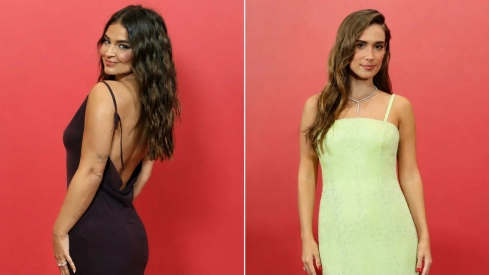
The controversy between María Pombo and Laura Escanes has once again jumped onto social media, and this time politics is the backdrop. The Catalan's decision to publicly show her intention to vote for the PSOE in the general elections on November 29 has caused a wave of reactions among content creators. Among them, María Pombo, who commented with an "amen" on a video that harshly criticizes Escanes for her political stance.
It all started when Laura Escanes posted a video on TikTok dancing with content creator Abel Planelles and a friend to the rhythm of the viral song "I am going to vote for you, Pedro Sánchez." It is a musical response to the phrase "No one is going to vote for you," uttered by Ester Muñoz, spokesperson for the PP in Congress. The publication quickly circulated on social media and even received a comment from the President of the Government, Pedro Sánchez: "Let's go, guys!"
However, the video also generated criticism. One of the most forceful came from Claudia Romero, a content creator who published a video on Instagram questioning the reaction that Escanes' positioning had provoked. In it, she even stated that the influencer was "a couple of steps below what is considered intellectual and ethical adulthood."
Romero defended that there is a double standard on social media when reacting to the political preferences of public figures. In her opinion, those who announce that they will vote for right-wing parties receive a targeting that does not occur in the same way when they express their support for left-wing formations. She also questioned that Escanes was receiving such a positive reaction for sharing her voting intention.
María Pombo responds with an "amen" and Laura Escanes denounces the insults
Claudia Romero's publication did not go unnoticed among other influencers. María Pombo left an "amen" in the comments, a gesture that was also seconded by creators such as Rocío Camacho, Ainhoa Rosado, Issa Moreno, and Laura Matamoros. The latter added an ironic message: "Long live that freedom of expression from the left. Equality for all, they say."
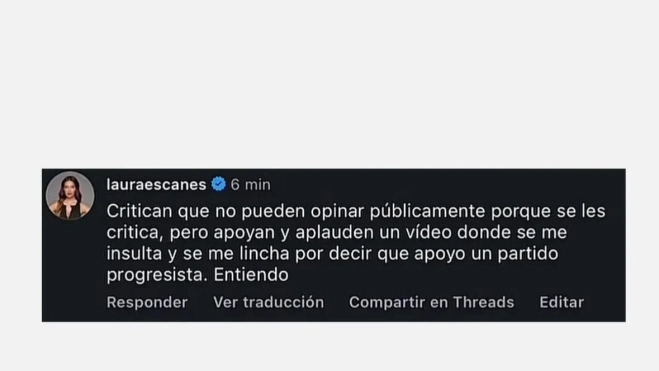
Pombo's reaction especially caught attention due to the history of her disagreements with Escanes. The Catalan responded through her Instagram stories, although without directly mentioning the businesswoman or the rest of the creators who reacted to the publication. "They criticize that they cannot express their opinion publicly because they are criticized, but they support and applaud a video where I am insulted and lynched for saying that I support a progressive party. I understand," Escanes wrote, making clear her indignation at what she considers a contradiction.
María Pombo's response came after the comment spread on social media. The influencer wanted to clarify the meaning of her "amen" and denied that she was endorsing the insults directed at Escanes. "Amen to being able to freely say who you are going to vote for without being lynched, insulted, or threatened for it. I wish we could all exercise that freedom without fear of the consequences," she clarified.
A new disagreement between two influencers who had already starred in controversies
This exchange of reproaches once again highlights the distance between two content creators who for years shared a circle of friends and public appearances. One of the previous episodes came after Laura Escanes participated in the program 'Al cielo con ella', presented by Henar Álvarez, where she talked about her reading habits.
Some users interpreted her words as a hint towards María Pombo, who months earlier had generated debate by admitting she didn't like to read. Pombo then published messages about respect and mockery, though without directly mentioning Escanes. The Catalan denied that her intervention was directed against her colleague and defended that she did not intend to mock anyone.
Now, with the general elections on November 29 just days away, the controversy has indirectly pitted both influencers against each other again. The debate is no longer limited to their personal differences: it has also opened a discussion about the public exposure of political preferences, the criticism content creators receive, and the limits between questioning an opinion and attacking the person who expresses it.
Contact
We are listening. Get in touch.
