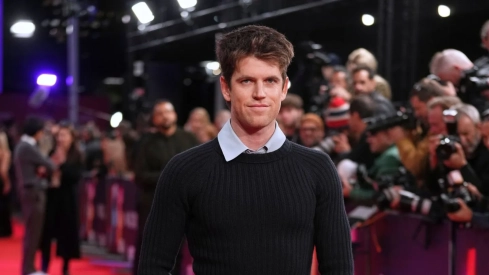
Miguel Bernardeau has taken advantage of the international promotion of La bola negra to comment on some of the social issues affecting Spain. During an interview with EFE at the London Film Festival, the actor directly pointed to Vito Quiles when asked who he would show one of the black balls that give title to Javier Calvo and Javier Ambrossi's film. His response was forceful: "I would show Vito Quiles a black ball as big as a cathedral." Furthermore, he extended his criticism to those who, in his opinion, hinder dialogue and coexistence.
Miguel Bernardeau points to Vito Quiles to advocate for dialogue against polarization
The actor's statement stems from the meaning of the black ball in the film, inspired by the unfinished work of Federico García Lorca: a gesture of rejection towards another person. Asked who would receive it in the current context, Bernardeau stated that he would show it to those who contribute to political and social polarization.
este hombre realmente se despertó un día y dijo voy a ser perfecto miguel bernardeau el icono que tú eres pic.twitter.com/3pQ7uodXZ4
— ale ⚫️ (@dilosinhablar) October 9, 2026
"To all the people who polarize opinion, who do not allow our country to share... to generate an environment of dialogue and peace," explained the actor, who also extended his response to those who hold extreme positions "to everyone who is an extremist in something, in politics, for example". His reflection concluded with a call for conversation between people with different ideas: "We need to be able to communicate, to be able to talk, to be able to dialogue".
Bernardeau's words are part of a promotion in which he has addressed issues that go beyond his cinematic work. The actor himself has acknowledged that questions about the film have opened the door to social and political conversations that were not so common in his interviews before.
The actor once again supports the young people camping in Puerta del Sol
Bernardeau has also publicly shown his support for the young people who remain camped in Madrid's Puerta del Sol to demand the right to decent housing. From London, the interpreter sent them "a very strong hug" and acknowledged their work in defending social rights.
The actor has linked these mobilizations to the accumulated discomfort among young people due to difficulties in accessing housing. "I see it as screwed up, I think young people cannot afford housing, that we are giving up these basic rights, it seems outrageous to me," he also expressed during his recent visit to the RTVE program Al cielo con ella, presented by Henar Álvarez.
In that intervention, Bernardeau defended the importance of citizen mobilization and recalled that these demands have been present for some time. His statements came in a context of renewed debate on access to housing, after the death of Maricarmen Abascal, the 87-year-old woman whose eviction had generated widespread social repercussions.
'La bola negra', a film that invites us to look at others without prejudice
The social dimension of the film has also been present in the statements of its directors. Javier Calvo has defended the potential of cinema to generate empathy and open debates, while the story raises the need to recognize the humanity of those who are perceived as different.
In that sense, the message connects with Bernardeau's reflection on polarization: beyond ideological differences, the actor vindicates the possibility of listening and dialoguing without turning the other into an enemy. The promotion of La bola negra has thus become a space from which to address both memory and diversity, as well as some of the problems affecting current society.