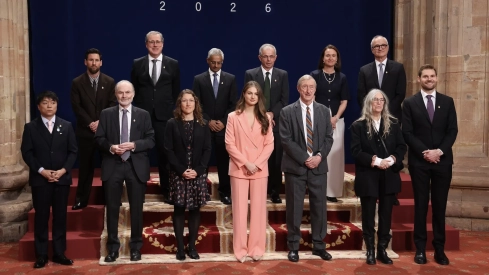
Patti Smith received this Friday, October 23, the Princess of Asturias Award for the Arts 2026 in a ceremony held at the Campoamor Theater in Oviedo. The American singer, poet, and writer arrives at the award ceremony after starring in one of the most emotional images of the week: thousands of people singing along with her one of the most representative songs of her career, People Have the Power.
Así ha recibido la princesa Leonor a la cantante estadounidense Patti Smith, Premio Princesa de Asturias de las Artes 2026 https://t.co/Phr1d8laOX pic.twitter.com/TOkb02ATr4
— RTVE Noticias (@rtvenoticias) October 23, 2026
The tribute took place this Thursday in the old Weapons Factory of La Vega, where around 3,000 people, including members of 78 choral groups and hundreds of anonymous voices, gathered to surprise the artist. Upon discovering the crowd, Smith put her hands to her face, visibly moved. "It's a surprise! Thank you very much!" she exclaimed before going on stage and performing the song accompanied by the impromptu choir.
An anthem that turned Oviedo into a single voice
The choice of People Have the Power was much more than a musical gesture. Released in 1988 and written with her husband, Fred "Sonic" Smith, the song defends people's ability to transform society and has become one of the most recognizable anthems of the artist's political commitment.
Sorpresa coral en DIRECTO a Patti Smith, galardonada con el Premio Princesa de Asturias de las Artes.
— RTVE Noticias (@rtvenoticias) October 22, 2026
Una amplia representación de la gran masa coral de la región y centenares de voces anónimas se unen para cantar 'People Have the Power', una de sus canciones más emblemáticas.… pic.twitter.com/OSZdXFOsv0
At the end of the performance, Patti Smith thanked for the tribute and explained that she had written the song hoping that one day she could live a similar moment. The scene summarized the bond she has built with several generations of followers: a relationship in which music functions as artistic expression, but also as an invitation to participate and not remain indifferent to injustices.
The meeting in La Vega was one of the most outstanding events of the awards week and preceded Friday's ceremony, in which the artist will officially receive recognition for a body of work that has transcended the stage.
Patti Smith receives the Princess of Asturias for different reasons
The jury has distinguished Smith for her creativity, capable of connecting rock, symbolist poetry and the spirit of counterculture with great expressive power. The act also highlights her way of embodying individual rebellion and her commitment to a message of hope in the face of injustices.
Born in Chicago in 1946, Patti Smith became a fundamental figure in the New York music scene of the seventies. Her album Horses, released in 1975, marked a turning point in the relationship between rock and poetry, and consolidated an artistic voice far removed from conventions. Since then, she has developed a career in which music, writing, photography and visual arts coexist.
Her influence goes beyond the punk with which she is usually identified. Smith has built a body of work traversed by literature, spirituality, memory and social criticism. This combination explains why the award recognizes not only her impact on popular music, but also her ability to inspire new generations of artists.
Her bond with Spain turns 50 years old
The visit to Asturias coincides with a significant date for the singer: this October marks 50 years since her first performance in Spain, held in Badalona in 1976. Half a century later, she returns to the country to collect one of the most important cultural recognitions of her career and to reconnect with an audience that has followed her artistic evolution for decades.
Smith has also expressed her admiration for Spanish culture. Among her references, she has mentioned Pablo Picasso, Federico García Lorca and Miguel de Cervantes. The artist has recalled that discovering a work by Picasso when she was 12 years old contributed to awakening her desire to dedicate herself to art.
Her visit to Asturias has included two concerts in Gijón and meetings related to the awards week. The choral tribute in Oviedo has added a collective dimension to a visit that combines institutional recognition with the affection of her followers.
From music to politics: Patti Smith's message
The award ceremony also comes after the artist publicly expressed her concern about the political situation in the United States. Smith has criticized President Donald Trump and has defended the importance of citizens participating in public life to drive change.
This stance connects directly with the message of People Have the Power. For the singer, the song represents the possibility for people to organize and act against what they consider unjust. Her political commitment is not an isolated element of her career, but a dimension present in her compositions and public interventions.
With the Princess of Asturias Award for the Arts, Patti Smith adds new recognition to a career that has made creative freedom and nonconformity two of her hallmarks. The image of thousands of voices accompanying her in Oviedo also offers a particularly symbolic way of receiving the award: with one of her best-known messages turned into a shared celebration.