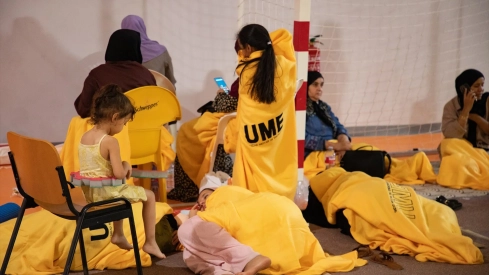
The wildfires that are devastating the southwest of the Community of Madrid and the area around Burgohondo, in Ávila, have already turned the air into another front of the emergency. Smoke, ashes, and the arrival of an air mass of African origin have worsened air quality and led health authorities in Madrid and Castilla y León to ask for maximum limitation of exposure.
The Ministry of Health of the Community of Madrid and the General Directorate of Public Health of the Junta de Castilla y León have issued a series of recommendations this Friday aimed at the entire population. The main one is to remain indoors whenever smoke is visible or a burning smell is perceived, especially in areas closest to the fires.
The warning comes in full national interest emergency, declared by the Ministry of Interior due to the severity of the fires in Villa del Prado and San Martín de Valdeiglesias, in Madrid, and Burgohondo, in Ávila. Around 25,000 people have had to leave their homes and in recent hours new evacuations have been ordered in Fresnedillas de la Oliva, Robledo de Chavela, Chapinería, Navas del Rey and Colmenar del Arroyo. Navalagamella remains confined.
Smoke and African dust worsen the air
Smoke from a fire contains gases and microscopic particles capable of penetrating the lungs. The smallest ones, known as PM2.5, can reach the deepest parts of the respiratory system and aggravate diseases such as asthma, chronic obstructive pulmonary disease, or cardiovascular pathologies.
💨 El #IFSierraOeste y la intrusión de aire africano están produciendo un deterioro de la calidad del aire en la región.
— Salud Madrid (@SaludMadrid) July 24, 2026
➡️ La @ComunidadMadrid recomienda a población vulnerable evitar las actividades al aire libre que supongan esfuerzo físico.
+Info: https://t.co/PbTonJ0Rqh pic.twitter.com/CNDbFgI4dr
The Community of Madrid has detected an increase in particle concentrations due to the coincidence of the fires and the arrival of African air. The most affected areas are the Alberche Basin, the Sierra Norte, and the urban agglomeration of the northwest, although the evolution will depend on the wind, meteorological conditions, and the advance of the flames.
The most frequent symptoms are cough, irritation of eyes, nose or throat, difficulty breathing, chest pain or tightness, headache, and fatigue. Babies, children, the elderly, pregnant women, and those suffering from respiratory or cardiac problems are at greater risk.
Close the house and use an FFP2 mask if you have to go out
Doors, windows, and any external air inlets must remain closed. Air conditioning can be used in recirculation mode and with clean filters. If the equipment draws air from the street, it is advisable to turn it off while smoke is still present.
Sources of contamination inside the home should also be avoided. Smoking, lighting candles, or using appliances that produce smoke worsens indoor air quality. Drinking water frequently and washing your eyes when irritation exists can help reduce some discomfort.
Sports activities, physical work, and outdoor children's games should be suspended in affected areas. If going out is essential, Castilla y León recommends using an FFP2 mask and protective glasses. Handkerchiefs, clothing, or dust masks offer insufficient protection against fine smoke particles.
🔥 La oleada de #incendios que afecta a distintas zonas de España está empeorando la calidad del aire en muchas localidades.
— Salud JCYL (@Salud_JCYL) July 24, 2026
La Dirección General de Salud Pública de la Consejería de Sanidad recomienda seguir estas indicaciones: https://t.co/RVxFrbiEVy#Sacyl #CastillaYLeón pic.twitter.com/yP9mnaP9md
People with chronic diseases should have their usual medication ready and consult their doctor if they notice an worsening. Difficulty breathing, an intense feeling of shortness of breath, chest pain, or burns require immediate medical attention.
How to act if the fire is near or an alert arrives
Any fire or smoke column must be immediately reported to the 112 telephone number, indicating the location as precisely as possible. If the flames are close, you must move away in the opposite direction to the smoke and wind and avoid ravines, slopes with dense vegetation, and areas towards which the fire may advance.
Authorities advise having a backpack ready with documentation, medication, water, phone charger, and basic items. An evacuation order must be complied with immediately via the marked route, without returning to collect objects or approaching evacuated areas until emergency services authorize it.
The Civil Protection Alert System through mobile phone networks, known as ES-Alert, sends notifications to all phones located within a risk zone without the need to install any application. When the alert sounds, you must read the full message and follow the specific evacuation or confinement order.
Thick smoke can almost completely eliminate visibility on the road. You should never try to cross a dense cloud or continue towards the fire. If smoke surprises the driver, they should close the windows, activate air recirculation, and stop only in a safe place, away from vegetation and without blocking the passage of emergency vehicles.
Health services recommend going to the health center for persistent symptoms and explaining that you have been in an area affected by a fire. In case of severe difficulty breathing, chest pain, burns, or immediate danger, the emergency phone number is 112.
