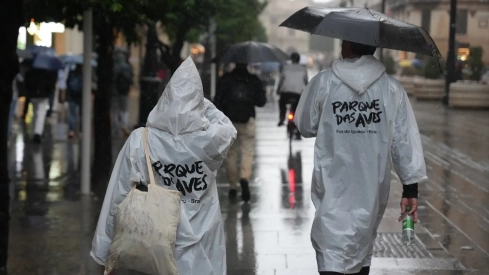
On Sunday, November 29, millions of Spaniards are called to the polls and, as happens in every election, in addition to political and organizational issues, there is also a factor that can influence turnout: the weather during the day. A rainy, cold, or foggy morning can alter the plans of part of the electorate and, consequently, affect participation.
The connection between meteorology and electoral participation is not just a popular perception. Different academic works have analyzed what happens when it rains, the temperature drops, or the sun appears on election day, and one of the most repeated conclusions is that precipitation tends to reduce attendance at polling stations.
In Spain, one of the most cited studies is the one published in 2014 by economist Joaquín Artés, from the Complutense University of Madrid, in the European Journal of Political Economy, under the title The rain in Spain: Turnout and partisan voting in Spanish elections. The research used precipitation records from more than 3,000 meteorological stations to analyze their relationship with the results of Spanish general elections, taking rain as an instrumental variable to study the effect of electoral participation.
The first major conclusion was clear: when it rains on election day, participation decreases. The study found that municipalities where precipitation was recorded showed lower turnout at the polls, with a moderate effect, close to half a percentage point in comparisons collected by subsequent research. It is not a massive abstention, but a small part of the electorate that may fail to attend.
The cost of leaving home
The most intuitive explanation points to the cost of traveling to the polling station. Rain adds a barrier, however small, to a decision that for some people may already not be a priority, as it involves taking an umbrella, walking on wet streets, driving with poorer visibility, or dealing with possible mobility incidents.
Those with high motivation to vote usually stick to their plans, but those who hesitate may postpone leaving and not end up going.
Cold, sun, and temperature also influence
Rain is the most analyzed meteorological phenomenon in relation to voting, but it is not the only one. A study published in 2012 in the International Journal of Biometeorology examined thirteen parliamentary elections held in the Netherlands between 1971 and 2010, with data from more than 400 municipalities, and crossed results with information on precipitation, hours of sunshine, and temperature.
According to that research, about 25 l/m² during election day were associated with a reduction of approximately one percentage point in turnout. Conversely, an increase of ten degrees was related to an increase of close to one point, while a completely sunny day showed a turnout around 1.5 points higher than one without hours of sunshine.
More recently, research published in 2023 in the journal Electoral Studies broadened the perspective with a meta-analysis of 34 studies on rain and electoral participation. Most of the reviewed works found a negative association between precipitation and attendance at the polls.
The analysis itself, based on data from Danish voters and detailed meteorological observations, estimated a reduction of 0.95 percentage points for each centimeter of rain.
An election Sunday with rising maximums
Meteorologically, the spokesperson for the State Meteorological Agency (AEMET), Del Campo, has announced that temperatures will continue to rise on Sunday. There will be hardly any frosts, although morning fog banks may form, in some cases dense, with reduced visibility. The highest probability of rain will be in Galicia and Asturias, although they may also be recorded in other parts of the Cantabrian coast and the northwest of Castilla y León.
Del Campo does not rule out that these precipitations may extend to other parts of the north and west of the Peninsula, although with lower probabilities. In this scenario, the coldest morning is expected in Teruel, León, Soria, Burgos, and Albacete, with a minimum of 2 ºC, while the highest maximum will probably be measured in Seville, with 21 ºC.
Looking ahead to next week, the forecast points to generally stable weather and temperatures without major changes, typical of this time of year, that is, cold. In addition, some weak rains could occur in parts of the Mediterranean.
Tiempo previsto el domingo #29N En cuanto a precipitaciones, un frente se va a ir desplazando por el extremo norte, con lluvias en Galicia y en las provincias del Cantábrico. Adjuntamos mapa de precipitación prevista cada 6 horas, de 7 a 13 (mañana) y de 13 a 19 (tarde) 🧵 https://t.co/4y9C1zUHdh
— AEMET (@AEMET_Esp) November 26, 2026
Canary Islands, with decreasing wind and evolving cloudiness
In the Canary Islands, the forecast indicates that it will rain in the north of the most mountainous islands during the next few days, especially in mid-slopes, with very strong wind gusts. Looking ahead to the weekend, including election Sunday, it is most likely that the wind will lose intensity and that evolving clouds may grow throughout the day, with some rain more likely in parts of the most mountainous islands.
Minimum temperatures in the archipelago will be between 19 and 21 ºC and maximum temperatures between 23 and 25 ºC in coastal areas.
Contact
We are listening. Get in touch.
