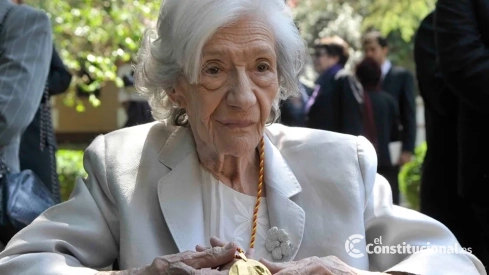
In 2025, the centenary of the birth of Ana María Matute, one of the great voices of Spanish literature of the 20th and early 21st centuries, has been celebrated. One hundred years after her arrival into the world, her work continues to resonate with an intensity that belies the passage of time. Matute did not only write novels and short stories: she built her own territory, populated by wounded childhood, eloquent silences, symbolic forests, and characters who view the world with equal parts wonder and pain. Celebrating her centenary is not a nostalgic gesture, but a reaffirmation of her relevance.
Throughout her career, Ana María Matute was recognized with the country's main literary awards: the Premio Planeta in 1954, the Premio Nadal in 1959 and, culminating an exceptional career, the Premio Cervantes in 2010. But beyond the awards, her true recognition has been the constant affection of generations of readers who found in her pages an intimate and shared truth. Matute knew how to tell what was often left unsaid: the postwar period experienced from childhood, the loss of innocence, injustice, loneliness and, despite everything, the persistence of hope.
Her figure reminds us that literature is not just an aesthetic exercise or an individual refuge, but also a form of collective memory. In Matute's work, writing was always a way to resist forgetting, to give voice to those who did not have it, and to preserve an ethical view of the world. The echoes of her centenary are heard today in reissues, public readings, critical studies, and, above all, in the silent dialogue that her books continue to maintain with readers.
Childhood occupies a central place in the literary universe of Ana María Matute. It is not an idealized childhood, but rather a space crossed by misunderstanding, cruelty, and the precocious learning of pain. Her boys and girls observe a hostile adult world, marked by violence and authoritarianism, and they do so with a disarming lucidity. In this sense, Matute was a different narrator of the post-war period: far from explicit testimony or the crudest realism, she opted for a symbolic, poetic, and profoundly human writing.
That childlike gaze became one of the hallmarks of her work. From her earliest stories to her most ambitious novels, Matute explored the fracture between innocence and experience, between the desire for justice and the reality of inequality. Her characters usually inhabit margins: forgotten villages, somber houses, forests that function as refuge and threat. In those settings, the fantastic and the real intertwine without stridency, as if they were two inseparable layers of existence.
Language was for Ana María Matute a moral tool. Her prose, apparently simple, is loaded with symbolic resonances and a very personal musicality. Each word seems chosen with care, not to impress, but to say just enough. That expressive restraint, united with a great evocative power, explains why her work continues to be so contemporary. In a time of excesses and noise, Matute reminds us of the value of silence and of measured words
Within the commemorative acts of the centenary, the Instituto Cervantes organized at the beginning of 2025 a far-reaching exhibition titled Quien no inventa no vive, curated by María Paz Ortuño and with the presence of her son, Juan Pablo Goicoechea Matute. The exhibition, which later traveled to Barcelona, offered a rigorous and emotional journey through his life and work. Among the many documents and photographs exhibited, an image with Jorge Luis Borges stood out for its symbolic strength and for the silent dialogue between two major literary universes.
The Royal Spanish Academy also joined the centenary with a massive conference in which Matute's career and the deep mark she left on contemporary Spanish literature were reviewed. It was an occasion to underline her stylistic uniqueness and her status as an essential author, capable of transcending generations and literary trends.
For its part, the Mutua Madrileña Foundation, within the Getafe Negro festival, convened the Matute Noir cycle, in which the writers Noemí Trujillo Giacomelli and Ana Merino participated. In these conversations, the elements of the crime novel present in Matute's work were addressed, aspects less explored but undoubtedly existing. Noemí Trujillo Giacomelli also published Una noche de Reyes (Destino, 2023), a book in which she establishes an imaginary dialogue with Ana María Matute and other writers awarded the Nadal Prize.
The centenary has also brought with it the republication of many of her works, confirming her permanent relevance. In this context, the Artelibro publishing house published The Universes of Ana María Matute, a biographical and literary journey that obtained the joint sponsorship of the Ministry of Culture and the Community of Madrid. A book that, like the centenary itself, contributes to keeping alive a voice that continues to challenge us through literature, memory, and conscience.
Radio Televisión Española also joined the commemoration of the centenary by recovering historical interviews and fragments of Ana María Matute's voice in the first person. Hearing her again —paused, ironic, profoundly lucid— allowed us to verify that her word is still alive, not only in audiovisual archives, but, above all, in the intimacy of her books. A voice that has not faded because it continues to dialogue with readers, crossing generations and confirming that literature, when it is true, does not age.
During one of the centenary encounters, Noemí Trujillo Giacomelli outlined a definition as provocative as it was accurate by stating that **Ana María Matute is "our Kafka."** Like him, Matute created **a unique, recognizable, and non-transferable universe, in which the symbolic reveals profound truths about the human condition.** Closing this centenary is, in reality, reopening its pages and accepting that her work does not belong to the past, but to that permanent territory where literature continues to help us understand the world and ourselves
Add ElConstitucional.es as a preferred Google source for free.
Stay informed about all the latest breaking news with the best information. Against disinformation, for democracy and social rights.