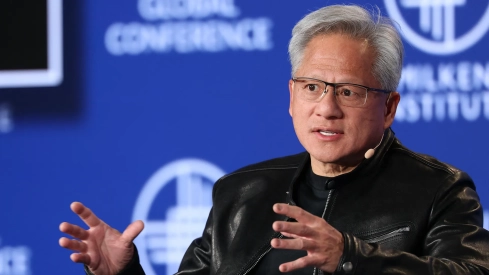
The debate about the risks that artificial intelligence can represent has intensified again in recent weeks. While some researchers and industry leaders warn of possible extreme scenarios derived from increasingly advanced systems, Jensen Huang, founder and CEO of Nvidia, considers that predictions about a possible human extinction lack scientific basis.
In an interview with CBS News, Huang was directly asked about the possibility of AI causing the end of humanity within the next decade. His answer was blunt: he believes there is a 0% chance that 2030 will mean the end of the world.
The executive called these types of warnings excessively dramatic narratives and argued that generating fear around the evolution of artificial intelligence is unnecessary and irresponsible. At the same time, he clarified that concern for the safety of these systems is legitimate and that companies must dedicate sufficient resources to ensure that their products are developed safely.
A debate divided between optimism and concern
Huang's statements come amid an increasingly intense discussion within the technology industry itself.
A part of the specialized community considers that the development of increasingly capable artificial intelligence systems could generate risks difficult to control, especially if at some point systems capable of acting autonomously and pursuing objectives that conflict with human interests appear.
Other researchers advocate a more pragmatic approach: they recognize that there are significant risks, but believe that they can be reduced through safety research, control mechanisms, and regulation. Huang clearly stands on the side of those who believe that stopping or slowing down the development of AI is not the right answer.
Nvidia wants the race to continue
The CEO of Nvidia also expressed support for maintaining the current pace of development. Asked if technology companies should slow down their advances, Huang argued that they should advance "as fast as we can".
His argument acquires an additional dimension due to the role Nvidia plays in the current race for artificial intelligence. Its accelerators are a fundamental piece of the infrastructure used to train and execute the most advanced AI models.
According to Epoch AI estimates, Nvidia concentrated approximately 68% of the computing capacity of AI chips marketed or shipped during the fourth quarter of 2025, measured in H100 equivalents. Google appeared in second place with 19%, while Amazon and AMD represented about 5% each. These data help to understand why any debate about the speed of AI expansion also has a business dimension for Nvidia.
Huang defends applying existing regulations
The executive also does not consider it necessary to necessarily create a new specific regulatory framework to address the risks of artificial intelligence. His position is that existing legislation should be effectively applied.
During the interview, Huang insisted that systems must be built safely, but rejected that the most extreme warnings justify slowing down technological innovation. He also raised the possibility that countries developing AI collaborate to establish common safety standards.
In the case of the United States and China, he also argued that both powers should share best practices and cooperate on security matters.
A position that also has a business component
Huang's statements must be interpreted taking into account Nvidia's role in the market. The growth of artificial intelligence has made specialized chips one of the essential components of the new technological infrastructure. The information collected by Epoch AI itself shows that Nvidia maintains a dominant position in AI computing capacity, although the figures are estimates and depend on the methodology used.
Therefore, Nvidia has a direct interest in the construction of new data centers and the demand for AI accelerators continuing to grow. This does not demonstrate that Huang's opinion on the risks of artificial intelligence is self-serving, but it does constitute a relevant element for contextualizing his statements.
The discussion, in any case, is far from resolved. Huang believes that the extinction scenarios proposed for the end of this decade are not supported by science, while other researchers maintain that future risks deserve much greater attention.
What seems clear is that the issue is no longer limited to research laboratories: the speed at which AI should advance has become one of the main technological, economic, and political debates of today.
Add ElConstitucional.es as a preferred Google source for free.
Stay informed about all the latest breaking news with the best information. Against disinformation, for democracy and social rights.