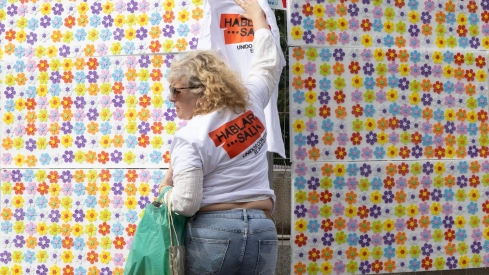
Each of the 3,953 flowers placed this Thursday in front of the Congress of Deputies by the Hablar Salva movement represents one of the people who died by suicide in Spain during 2024. The image has brought back to the center of the debate a reality that remains hidden for much of the year and that continues to leave thousands of families traversed by pain, guilt, and too many unanswered questions.
The latest provisional data from the Statistics on Deaths according to Cause of Death from the National Institute of Statistics count 3,808 deaths by suicide in 2025. This is 145 fewer than the previous year, a decrease of 3.7%, and 419 fewer than in 2022, when the maximum of the recent series was reached with 4,227 deaths. The rate has dropped from 8.09 to 7.71 deaths per 100,000 inhabitants.
The evolution confirms a decrease for three consecutive years, although the magnitude remains difficult to ignore. In 2025, more than ten people died from this cause every day and suicide ranked third among external causes of death, behind accidental falls and drownings. Among men, it continued to be the leading external cause of death.
Men account for 73% of deaths
Of the 3,808 people who died in 2025, 2,784 were men and 1,024 were women, according to provisional data released by the INE. 73% of the deaths correspond, therefore, to males. The largest number of cases is concentrated among those aged 45 to 64, with 1,578 deaths, followed by the group aged 25 to 44, with 850.
The Doctor in Political Science and Sociology Cristina Blanco, director of the postgraduate program in Suicidology at the University of the Basque Country, has warned of the need to specifically address this gap. "If we want to reduce the number of suicides in Spain, we have to address male suicide," she explained in an interview published by 'El País'.
The difficulty in expressing suffering, asking for help, or recognizing a situation of vulnerability appears recurrently in studies on male suicide. Expectations linked to strength, self-sufficiency, or the role of provider can delay access to professional care, especially when combined with work, economic, family, or health problems.
The World Health Organization reminds that suicidal behavior responds to a combination of social, cultural, biological, psychological, and environmental factors. Economic crises, loneliness, discrimination, grief, violence, personal conflicts, or chronic pain can increase the risk. Prevention also requires acting on the living conditions that sustain such suffering.
The 024 exceeded 204,000 calls in one year
The dimension of the demand for help appears with special clarity in the annual report of the 024 Line of the Ministry of Health. The service handled 204,449 calls during 2025, of which 162,184 were telephone calls and 42,265 conversations through chat. The figure counts attended contacts and may include several communications from the same person.
A total of 11,947 calls and 1,275 chats had to be referred to 112 due to situations requiring urgent intervention. The pressure continued during 2026. In June alone, the last month with published information, the 024 handled 15,244 calls and responded to 5,259 chat conversations. More than a thousand calls ended up being transferred to emergency services.
The written channel also shows the weight of the young population. Among those who provided their age during 2025, 64.6% of chats corresponded to people under 30 years old and the 15 to 19 age group was the one that most resorted to this channel. The data describe the profile of those who contacted the service and do not constitute an estimate of the entire Spanish youth.
The ANAR Foundation offers another relevant signal. Of the 19,990 children and adolescents it helped during 2025, 6,467 presented suicidal behaviors and 1,405 had initiated an attempt, according to the annual report of its helplines. Also in this case, these are minors attended by the entity, so the figures should be interpreted within that scope and not as national prevalence.
Psychologist Germán Ricardo, technical director of the Teléfono de la Esperanza de Alicante, insisted this Thursday on the importance of listening to any verbalization. "If a person talks about having suicidal thoughts, they are looking for help," he explained in 'Hoy por Hoy Alicante'. Asking with respect, listening without judging, and facilitating access to professionals allows opening a path of support when suffering is already difficult to manage.
Health prepares the first state suicide registry
The Minister of Health, Mónica García, announced this Thursday that her department is finalizing the royal decree that will regulate the Mental Health Surveillance System, within which the first State Suicide Registry will be created. Spain currently works with health, statistical, and medical-forensic information collected using criteria that may vary between territories.
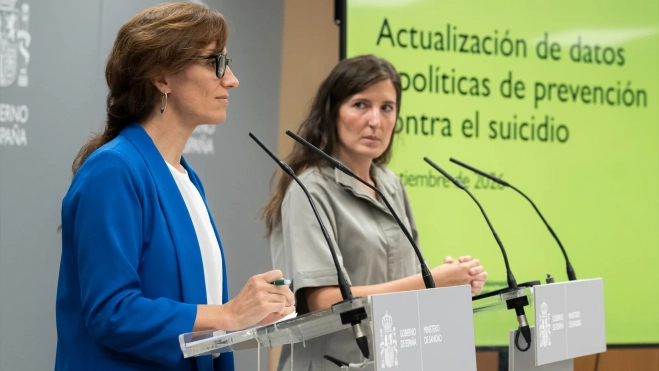
The future system will establish common procedures to gather homogeneous and comparable data across all autonomous communities. A central unit and a technical committee will analyze the information to detect trend changes, unexpected case concentrations, and new risk patterns. "The idea is to move from looking at reality through the rearview mirror to having a radar that warns us in time," García explained.
The minister argued that the registry will allow "to arrive earlier to prevent", better guide public policies, and improve care response. She also placed suicide outside of an exclusively health-focused view. "Many health, social, labor, educational, economic, and community factors intervene," she pointed out during the presentation.
The project is part of the Suicide Prevention Action Plan 2025-2027, funded in 2025 with 17.83 million euros and developed through 122 projects. Among the funded actions are home care programs for adolescents with suicidal ideation, initiatives against loneliness in rural areas, and efforts to identify high-risk spaces.
The Commissioner for Mental Health, Belén González, summarized the approach that the Ministry of Health wants to convey to these programs. "Mental health does not need aerospace technology, it needs people, presence, connection, and time," she stated. The Ministry still has to specify when it will approve the royal decree that will cover the new state registry.
Help resources. People with suicidal thoughts and their family members or close relatives can call 024, a national, free, and confidential service available 24 hours a day, or 112 when there is an immediate emergency. The Teléfono de la Esperanza also attends at 717 003 717. Minors can contact the ANAR Foundation at 900 20 20 10 or through the anar.org chat. The Papageno Association maintains a map of specialized resources and support groups available in Spain at papageno.es.
Add ElConstitucional.es as a preferred Google source for free.
Stay informed about all the latest breaking news with the best information. Against disinformation, for democracy and social rights.
