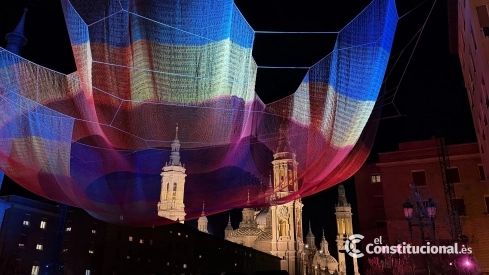
The festival Zaragoza Luce 2026 inaugurated yesterday February 19 its second edition, transforming the Historic Center of Zaragoza into an open-air museum full of light, color, and contemporary art, which can be visited until February 22, 2026. And from the newspaper Elconstitucional.es we did not want to miss it.
This year the proposal is expanded with 12 light interventions by international, national, and local creators, displayed in emblematic locations such as Plaza del Pilar, Plaza San Juan de los Panetes, Plaza del Justicia, the Hispanidad fountain, the facade of the Official College of Architects and the Diocesan Courtyard of the Alma Mater Museum, among other points in the historic center.
The facilities combine technology, sound, and immersive design, inviting the public to rediscover the city from an artistic perspective. Figures such as works by Lateral Office, Cédric Le Borgne, Janet Echelman, Collectif Scale or creations by the collective Groupe LAPS coexist with local proposals, including an intervention by the students of the Escuela de Arte de Zaragoza alongside artist Néstor Lizalde.
The event, organized by the Zaragoza City Council with the aim of attracting top-level cultural proposals, seeks to be accessible and free for all ages, in addition to offering a pedagogical and formative character for students of art and creative techniques, with professional networking days and parallel activities.
The works will remain lit every afternoon between 7:00 PM and 12:00 AM, offering a nocturnal tour that fuses heritage, creativity, and citizen participation in an atmosphere of light and urban spectacle.
Photographs at the scene
Personally, I especially highlight Les Voyageurs by Cédric Le Borgne and Earthtime 1.26 by Janet Echelman for the way in which both transform the urban space and our way of perceiving it.
Earthtime 1.26 impresses me with its scientific basis and symbolic strength. The fact that its form is inspired by a real earthquake that altered the planet's time adds a very powerful conceptual depth. Furthermore, its constant movement with the wind creates a living and changing experience, where art, science, and nature dialogue in perfect harmony.
On the other hand, Les Voyageurs, spread across 5 different locations, caught my attention for its poetic and almost dreamlike dimension: those suspended figures that appear and disappear in the sky invite us to look at the city with different eyes. I like how the work connects with the "child within us" and turns the everyday into something magical, reminding us that the city is not just a place of transit, but a space to imagine, play, and reflect.
"Earthtime 1.26" by Janet Echelmen and "Les voyageurs" by Cédric Le Borgne/ Luis Corpas | ElConstitucional.es -