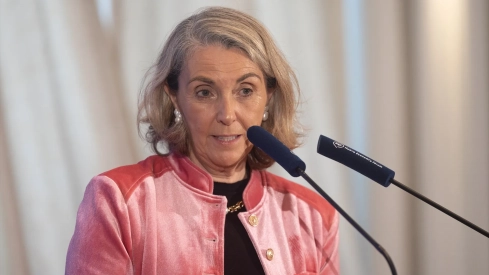
The president of UNICEF Spain, María Ángeles Espinosa, defended this Friday the approval of the universal child-rearing benefit, considering that "it would be a truly effective measure to lift many boys and girls out of child poverty," an initiative that, she said, she would receive "with great joy" if it finally goes ahead.
Espinosa made these remarks during an informative breakfast of Nueva Economía Fórum, when asked about the possibility that the last Council of Ministers before the elections on November 29 would approve this aid. The president of UNICEF Spain recalled that this is a sustained demand of the organization and referred to a study published in November of last year on the impact of different measures against child poverty.
"The universal benefit for dependent children was the measure that lifted the most boys and girls out of child poverty," said María Ángeles Espinosa, without specifying in her speech an amount for the aid or a number of potential beneficiaries.
Childhood, at the center of the electoral debate
Ahead of the elections on November 29, the president of UNICEF Spain has asked political parties to place childhood at the "center" of their decisions and to listen to the proposals of the children themselves. "Although children do not vote," she warned, they are "the main recipients" of all decisions adopted during a legislature.
Among the "basic and strategic priorities," she cited the reduction of child poverty, access to housing for families with children, mental health, protection on social networks, attention to migrant minors, and official development assistance. These are issues that children and adolescents conveyed to political representatives of the PP, PSOE, Vox, and Frente Amplio in an electoral debate promoted by UNICEF within the initiative 'Childhood in an envelope'.
Espinosa indicated that in that meeting there were "clearer" commitments in some areas than in others and announced that the organization will monitor their fulfillment once the electoral results are known and the next Government is formed.
Child poverty, housing, and work-life balance
In her speech, the president of UNICEF Spain maintained that, "unfortunately" and despite all the "achievements" and "progress," inequality persists. "There are boys and girls who are in a situation of great vulnerability," she warned, placing poverty, mental health, and the risks of the digital environment as the main challenges facing minors in Spain.
Espinosa highlighted a child poverty rate of 28.4%, which she presented as the "highest in the European Union," and warned of the contrast between the decrease in poverty among adults, "thanks to the measures that have been adopted in recent years," and its increase among children.
She also focused on the cost of housing and food, which even forces families with one or two working adults to consider "either paying the rent or being able to provide healthy and balanced food for their children."
In addition, she called for a review of work-life balance policies from a child's perspective and questioned the use of extracurricular activities to cover the gap between school and work schedules, instead of responding to children's interests. "Not because that child likes to play soccer," she illustrated, but because their parents have not yet arrived. "There we have an pending issue," she pointed out.
Social networks, mobile phones, and mental health
In the digital sphere, María Ángeles Espinosa rejected the general prohibition of mobile phones and social networks as a response to excessive use, and advocated for "educating" children, families, and society, in addition to involving technology companies, to which she attributed a "very important" role.
However, she defended restrictions for "harmful" content and gambling, with effective age verification mechanisms. Similarly, she called for more specialized professionals to prevent and detect mental health problems early.
Contact
We are listening. Get in touch.
