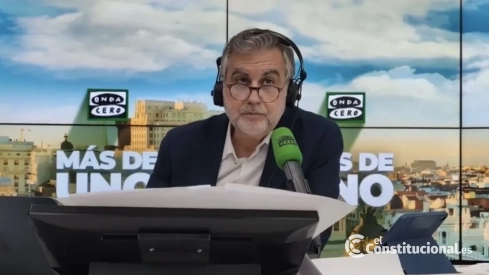
The journalist Carlos Alsina has questioned the statements of Ursula von der Leyen about the supposed end of the international order during his monologue on the program Más de uno. The communicator questioned that the president of the European Commission conveyed a position on the conflict in Iran without there being a prior institutional debate in the European Union.
During her intervention, Alsina considered that Von der Leyen's position current avoids openly criticizing the actions of Donald Trump in Iran, even when this stance clashes with that maintained by countries like France, Italy or Spain. According to the communicator, those governments do not regret the death of the Iranian leader, but they do question the violation of international legality.
The journalist Carlos Alsina stressed that the open debate after the words of Ursula von der Leyen is profoundly European, as it affects issues such as international rules, consensuses and discrepancies among member states. Therefore, he considered that the first thing the president of the European Commission should clarify is “on behalf of whom she speaks”, especially when within her own team there are voices that disagree with that vision, such as Vice-President Teresa Ribera.
Alsina also warned that public officials must differentiate between their personal opinion and the position of the institution they represent. "Those who hold public office must be scrupulous in distinguishing their personal position from that of the institution they embody", he stated. In that sense, he compared the situation with criticisms that in Spain have been directed at President Pedro Sánchez for expressing international positions without previously consulting other political forces.
In his reflection, Alsina also stated that if the international order based on rules truly already belongs to the past —in allusion to The World of Yesterday by Stefan Zweig— Europe should explain what the alternative is. The journalist questioned what exactly that “more realistic” foreign policy that some leaders demand means and what role the European Union should play in a global context marked by leaders who use military or economic force to impose their decisions.
Alsina pointed out that, in the short term, the priority of European countries is to contain a possible regional escalation, protect strategic points like Cyprus and prevent the conflict from reaching NATO allied countries like Turkey. To this are added the economic consequences of the war, which are already reflected in the rise in fuel prices and in how it is affecting the stock market.
The communicator also showed skepticism towards the optimism expressed by Donald Trump, who has predicted that the war is practically over and that its outcome will be favorable. Faced with that scenario, he stressed that the national leaders —among them the president of the Spanish Government, Pedro Sánchez— will be the ones who must make decisions and be accountable to their citizens.
💜 @albaleiva97 at the XL meeting of the XX of @Juliaenlaonda: "We cannot allow feminism to become an empty shell where anything fits or for others to appropriate it with discourses that truly go against feminist ideas"
— Onda Cero (@OndaCero_es) March 9, 2026
📲 Read the news here… pic.twitter.com/2ggQaydHAc
To close his reflection, Alsina resorted to a metaphor about an archer who, determined to shoot arrows every night to reach the moon, ended up becoming the best shooter in his environment despite never achieving his goal. However, the journalist warned that the insistence on shooting without measuring the consequences can end up turning against whoever shoots the arrow, in allusion to the political risk of acting with excessive audacity in such an uncertain international context.
Add ElConstitucional.es as a preferred Google source for free.
Stay informed about all the latest breaking news with the best information. Against disinformation, for democracy and social rights.