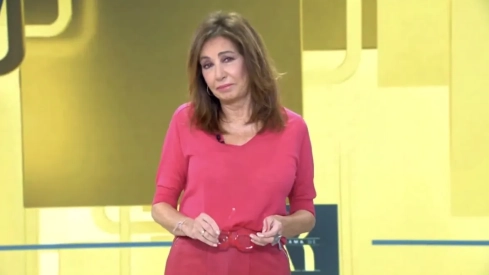
Ana Rosa Quintana has surprised this Thursday with a strong message about Javier Milei's visit to Spain. The host of El programa de Ana Rosa has questioned the Argentine president's insults to Pedro Sánchez and has defended that, beyond political differences, it is not admissible for a foreign leader to address the head of the Spanish Government in such terms.
"The Argentine president —this is the truth, and let it be known— cannot come to Spain to insult our president; the string of insults we have heard from him is inadmissible," she stated during her editorial. A declaration that marked the beginning of her intervention, in which she also analyzed the political effect that the Argentine leader's visit could have.
The journalist warned that the confrontation could end up benefiting Sánchez himself at a particularly delicate moment for the Government. "He has done the Government's campaign for them, because those insults are fuel in this pre-campaign, which is already hotter than it should be," she pointed out. Along these lines, she summarized her argument with another phrase: "Every insult is a vote."
However, Ana Rosa has not set aside her criticisms of the Spanish president. The host has maintained that Moncloa is taking advantage of the visit to turn Milei into a political adversary and reinforce the Executive's discourse. "Every superhero needs a villain," she noted, before questioning Sánchez's communication strategy and recalling some of his references to the left.
.@anarosaq: "Milei no puede venir a España a insultar a nuestro presidente. Es inadmisible"
— El programa de AR (@programadear) October 22, 2026
🔵 Arranca #ElProgramaDeAR22O en @telecincoes https://t.co/wQaFY3z4WE pic.twitter.com/kqfQLBxVNi
The intervention has ended by mixing irony and political criticism. Ana Rosa has resorted to the term "lefty", used by Milei in a derogatory way, to question Sánchez's ideological trajectory and his parliamentary pacts. "In reality, the president is not a lefty, he is very right-handed," she concluded, in an editorial in which she censored the insults of the Argentine president without renouncing her usual reproaches to the head of the Executive.