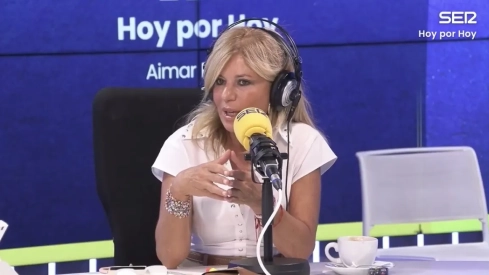
Esther Palomera has analyzed in Hoy por Hoy, on Cadena SER, the Government's management of the migratory crisis in Ceuta and has focused on the responsibilities that still need to be clarified. The journalist considers it understandable that Pedro Sánchez tries to maintain the diplomatic relationship with Morocco, although she believes that this should not prevent examining the role that the neighboring country could have played in what happened.
“The President of the Government can make all the efforts he deems necessary and I also understand, from the point of view of a head of Government, taking into account the history of diplomatic relations between Spain and Morocco, that an attempt is made to encapsulate, sweeten, underestimate or downplay Morocco's responsibility”, she pointed out.
Palomera considers, however, that there are still important issues to resolve. “I personally believe that Morocco, by action or omission, has a responsibility just as the Government of Spain does”, she affirmed. The journalist has focused on determining what happened during the days of greatest migratory pressure and, above all, “who did not realize” the dimension that the situation could reach.
In her analysis, she also questioned the initial perception that may have existed within the Executive. In her opinion, “the Government mistakenly understood that this was a summer crisis, just another summer crisis that would die with the summer”, a forecast that, she believes, has not been fulfilled.
🗣️ @estherpalomera, en #ElPulso: "Marruecos, por acción o por omisión, tiene una responsabilidad como la tiene el Gobierno de España"
— Hoy por Hoy (@HoyPorHoy) September 1, 2026
"Desde el Gobierno se entendió que esta crisis moriría con el verano, y no ha sido así. Si algo demostró ayer Sánchez es que con Ceuta está solo" pic.twitter.com/LspHcpy4FL
Therefore, Palomera believes that Sánchez now faces the challenge of conveying to public opinion that the Government is using all available resources to try to channel the situation. “The President of the Government has to make enormous efforts to demonstrate or convince public opinion that he is putting all resources and all political effort into solving this”, she explained.
The journalist has also focused on the political context in which the Executive is facing the crisis. With general elections that could be held in the coming months, she considers it difficult for the situation in Ceuta not to end up being incorporated into the electoral debate. “It is very difficult for this debate not to be used in an electoralist way by all parliamentary groups,” she pointed out. Palomera believes that Sánchez's appearance also left an image of a lack of sufficient political support for the president.
“If something the appearance of the President of the Government demonstrated yesterday is that he is alone in this,” she stated. In her opinion, Sánchez does not have the support of the opposition—something she considers part of their role—but neither does he have complete support from his parliamentary partners, while there are also discrepancies within the government itself.
Palomera's analysis thus outlines a crisis that remains open and that, in addition to the unknowns about what happened, adds a political difficulty for the Executive: managing the situation in Ceuta while opposition pressure grows, differences emerge among its allies, and a new electoral cycle approaches.