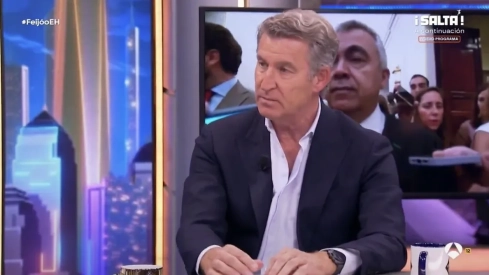
The president of the Popular Party, Alberto Núñez Feijóo, stated during his interview on the program El Hormiguero that he sees it as "very possible" that the PSOE could end up judicially charged for its alleged relationship with the so-called "sewers" that, as he denounced, would have acted against judges, prosecutors, journalists, and members of the Central Operative Unit (UCO).
.@NunezFeijoo: "Todo parece indicar que el PSOE caerá imputado" #FeijóoEH pic.twitter.com/LqbzOheCwF
— El Hormiguero (@El_Hormiguero) June 17, 2026
Asked about this possibility, Feijóo assured that, "technically and with the Penal Code in hand," there are indications to suggest that the party could be affected by an investigation. In his speech, he also questioned how certain activities would have been financed and alluded to statements made before the courts about alleged money movements at the socialist headquarters.
Beyond this issue, the popular leader took advantage of his appearance on Pablo Motos' show to redouble his criticism of Pedro Sánchez's government. Feijóo stated that he would not govern with the Executive's current parliamentary support and defended that he is willing to promote a motion of no confidence with the rest of the Chamber's groups, with the exception of EH Bildu, with the aim of forming a new government and calling elections.
.@NunezFeijoo pone el foco en la gestión de Pedro Sánchez y deja clara su visión sobre el rumbo del Gobierno #FeijóoEH pic.twitter.com/qEx3sdjQqD
— El Hormiguero (@El_Hormiguero) June 17, 2026
During the interview, he also directed his criticism at former president José Luis Rodríguez Zapatero, whom he described as "the jewel of Sanchismo" and "Sánchez's moral reference," in reference to the key figure he is within the current socialist political project. Feijóo also questioned some of the information related to the investigations affecting his circle and demanded public explanations.
The same leader, who in his day claimed not to know about Marcial Dorado's activities when he vacationed with him, maintained this Wednesday that Pedro Sánchez should have been aware of Leire Díez's actions and the corruption cases affecting the PSOE. To justify this, he resorted to an experience from his time leading the Xunta de Galicia, explaining that when he detected dubious situations involving public officials, he would ask his counselors for immediate explanations. "When I was going to inaugurate a work and I saw a public works director with a fancy car, I would call the counselor and ask him: how is it possible for a civil servant to have a car like that? As long as it wasn't clarified, there was suspicion," he recounted. From there, he concluded that, in his opinion, if the President of the Government knew only a part of the facts, he should assume responsibility for corruption, and if he had no knowledge, he would be demonstrating incompetence in the management of his party.
The popular leader also defended his management at the head of the PP and assured that he has never tolerated cases of corruption in his team. "I have never dipped my hand in the till in my life," he affirmed, while promising to restore "decency" to Spanish politics if he reaches the Presidency of the Government. "This Government specializes in stories and not in accounts," he stated during the interview, where he also criticized the high public debt and tax pressure.
.@NunezFeijoo explica qué pueden esperar los españoles de él si llega a la presidencia del Gobierno #FeijóoEH pic.twitter.com/adM1fGRRW6
— El Hormiguero (@El_Hormiguero) June 17, 2026
In the final stretch of the interview, the opposition leader directed his criticism at RTVE, which he again referred to as "Sánchez's television." Feijóo defended the need to promote a "democratic regeneration" which, he said, would prevent any government from influencing institutions such as the Attorney General's Office, the Constitutional Court, or the public radio and television corporation.
The opposition leader also opened the door to future government agreements with Vox, although he set a series of conditions that he defined as essential. Among them, he cited respect for the Constitution, the autonomous model, equality policies and LGTBI rights, as well as fiscal discipline, economic growth, and an "ordered and rational" migratory policy.
El papel de Abascal en la presidencia de @NunezFeijoo #FeijóoEH pic.twitter.com/QfxoYiZqVT
— El Hormiguero (@El_Hormiguero) June 17, 2026
In parallel, the popular leader defended his position on sensitive social issues. In the case of abortion, he assured that he would not modify the current term law if he reaches Moncloa and even referred to the voluntary interruption of pregnancy as a “right”, although he later clarified his words by calling it a woman's “decision”. In this sense, he indicated that his approach would involve strengthening the information provided to women before making a decision.
However, he did propose changes to the euthanasia law, considering that it is a norm that should be reviewed to incorporate “more consensus”, both political and professional, in the healthcare field.
Add ElConstitucional.es as a preferred Google source for free.
Stay informed about all the latest breaking news with the best information. Against disinformation, for democracy and social rights.