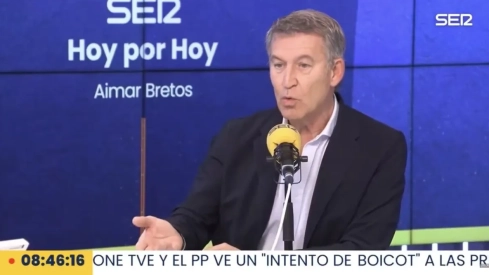
Alberto Núñez Feijóo has made a slip during his interview with Aimar Bretos on Cadena SER when addressing the Popular Party's wage policy. Asked if he commits to maintaining the pace of minimum interprofessional wage (SMI) increases, the opposition leader defended that his party wants to negotiate revisions with social agents, but ended up confusing the average wage with the minimum wage. "The Popular Party is against raising the average wage and, therefore, for the average wage to rise, the minimum wage has to rise," he stated. From the context of the conversation, it seems he wanted to refer to the minimum wage, after having denied that the PP is against increasing it.
The minimum wage, criticism of the Government, and workers' money
On economic matters, Feijóo avoided committing to maintaining the pace of SMI increases in recent years. "The commitment of the Popular Party, I reiterate, is to meet with unions and social agents and agree on the minimum wage," he explained. He also criticized the Executive for deciding on revisions without consulting all economic agents and linked this policy to a fall in productivity and competitiveness, as well as a loss of convergence with the European Union.
Asked if he believes the minimum wage has risen too much, he avoided answering directly and defended that the PP is not against increasing it, but rather wants to negotiate its evolution with unions, employers, and the Government. Feijóo recalled that, according to his figures, the employers' association has distanced itself from seven of the eight increases approved by the current Executive and added: "The one who has taken the most money from workers has been the Government." He then criticized the increase in business contributions and the effect that salary changes can have on the taxation of some workers. Bretos replied that the minimum wage was already exempt from income tax (IRPF), which led to an exchange about the tax treatment of these incomes.
Feijóo declares himself a feminist, but proposes changes in the Ministry of Equality
The interview also left an exchange about feminism and the structure of the future PP Government. Asked directly about his convictions, Feijóo replied: "How can I not be a feminist if I was raised in my home with many more women than men?". The popular leader defended that women have the same rights as men and acknowledged that there is still a wage gap.
However, when asked about the future of the Ministry of Equality, he indicated that he would not maintain the current 22 ministries. Although he rejected that he would abolish equality policies, he explained that the person in charge of this area would also have to assume other responsibilities. "I am going to tell the minister, male or female, who is in charge of Equality to take care of other things," he stated, before criticizing that the current head can "work from eight to three and go to Valladolid on the AVE to spend the afternoon."
🗣️ @NunezFeijoo: "No mantendré el Ministerio de Igualdad. Le voy a decir al ministro que se encargue de otras cosas"
— Hoy por Hoy (@HoyPorHoy) October 23, 2026
"Me considero feminista, me he criado con muchas más mujeres que hombres en mi casa" pic.twitter.com/IckwDmHwIQ
His position on abortion and minors aged 16 and 17
Aimar Bretos also asked him if the PP would reinstate the requirement for parental authorization for 16 and 17-year-old girls to have an abortion, a question that Feijóo did not close with a specific legislative proposal during the interview.
The popular leader referred to a letter published on his social networks after the Constitutional Court ruling and assured that he would guarantee women medical assistance to terminate pregnancy in accordance with the law, both in public and private healthcare. At the same time, he pointed out that he cannot force a doctor to perform an abortion and defended that a 16-year-old minor should share with her parents a decision that he considers "vital, transcendent, and important".
When Bretos asked him if he was talking about knowledge or legal permission, Feijóo insisted that he was referring to the parents' knowledge, although he added that he is willing to raise the debate because he believes that Spanish society has the right to reflect on it.