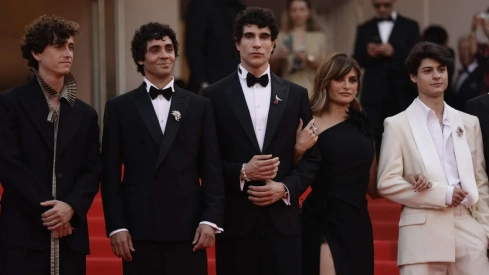
The premiere of The Black Ball, the new feature film by Javier Ambrossi and Javier Calvo, known as Los Javis, has been one of the great events of this edition of the Cannes Film Festival. The film, starring Penélope Cruz and based on an unfinished fragment by Federico García Lorca, has been received with an 18 to 20-minute ovation, placing it among the longest of the festival and nearing some of the historical records of the event.
Twenty minutes of ovation (according to Deadline) allow for a lot.
— Marta (@3martamp) May 21, 2026
Here, some moments of tears and happiness during the applause received by the LA BOLA NEGRA team at #Cannes2026: pic.twitter.com/pFxrYYYrko
The film is structured as a choral narrative in three time periods —1932, 1937, and 2017— intertwining stories united by LGTBI identity, desire, and memory. In one of the narrative threads, a young man is expelled from a social club in Granada after being singled out by rumors about his sexual orientation through the symbolic “black ball”. In another, a soldier in the midst of the Spanish Civil War lives a relationship marked by repression and ideological violence. The third timeline, already in 2017, follows a writer and historian who discovers an unexpected family connection that reopens a hidden past, building the emotional core of the film.
The cast is headed by Guitarricadelafuente as Sebastián, Carlos González as Alberto, Miguel Bernardeau as Rafael Rodríguez Rapún, Lola Dueñas as Teresa, Milo Quifes as Carlos, Penélope Cruz as Nené Romero, Glenn Close as Isabelle Durand and Alberto Cortés in the role of Federico García Lorca, in a structure that intertwines historical fiction and emotional memory.
The screening at the Gran Théâtre Lumière was marked by strong emotion in the hall, with the audience visibly captivated throughout the projection. International critics have highlighted the project's formal and narrative ambition, as well as its ability to address queer memory from different eras, combining the pain, desire, and emotional heritage of several generations. Media outlets such as The Hollywood Reporter also emphasize its powerful visual language, based on silences, atmosphere, and symbolism, rather than explicit dialogue.
After the screening, Los Javis offered a speech of marked vindicative character in which they recalled the assassination of Federico García Lorca by fascism due to his sexual condition and warned about possible setbacks in the rights of the LGTBI collective. “We are here to stay,” they proclaimed before an auditorium that responded with new applause, turning the premiere into one of the most political, emotional, and commented moments of the festival.
Los Javis sweep in #Cannes2026 amidst tears, olés and a spectacular ovation with a powerful speech: "90 years ago Lorca was assassinated by fascism because he was gay. Bad news for those who think we are going to backtrack on rights" https://t.co/W2TrSBicnz pic.twitter.com/nDekH67N7K
— El cine en la SER (@ElCineEnLaSER) May 21, 2026
Add ElConstitucional.es as a preferred Google source for free.
Stay informed about all the latest breaking news with the best information. Against disinformation, for democracy and social rights.