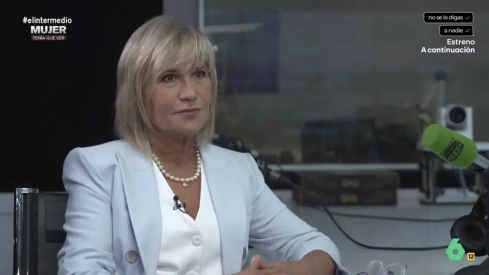
Julia Otero was one of the protagonists of the latest installment of El Intermedio, where she conversed with Sandra Sabatés in the section Mujer tenía que ser. During the interview, the journalist took stock of her career, recalled the difficulties she encountered when making her way in the media, and took the opportunity to reflect on the current situation of feminism.
As soon as the conversation began, Otero confessed her excitement to participate in the La Sexta program, which she defined as "one of the best television programs made in our country". However, she made it clear that she does not usually look back with nostalgia when thinking about her professional career.
"I am not nostalgic at all," she explained, assuring that she only goes back to the past to recognize "the foundations of the woman and the journalist" she has become since she began her career more than 40 years ago. For her, accumulated prestige never guarantees anything in a profession as changing as communication: "All the past, however dazzling, awarded, or laureled it may be, all that can vanish in an instant," she reflected.
During the interview, Sandra Sabatés highlighted Otero's role as one of the most influential women in Spanish media and asked her how she experienced those first years in a profession mostly dominated by men. The journalist acknowledged that it was not an easy path. She recalled that, both in radio and television, it was common to find herself as the only woman at debate tables made up of seven or eight men, a situation that constantly placed her in the minority. Even so, she assured that she never stopped fighting to make a place for herself.
🔴 @sandrasabates11 charla en #MujerTeníaQueSer con la periodista Julia Otero. #elintermedio pic.twitter.com/7X1tmeWbDf
— El Intermedio (@El_Intermedio) July 1, 2026
Otero also defended the work done by many professionals of her generation, although she regretted that the recognition received has not always been the same as they would have obtained had they been men. Far from considering that this inequality belongs to the past, she maintained that there are still important challenges to face. As an example, she cited the recent evolution of Cadena SER's programming, where, she pointed out, female presence has significantly decreased: "It is not true that we have everything".
The interview concluded with a reflection on the debate surrounding feminism. Otero questioned those who argue that the movement has gone too far and contrasted that idea with other areas of the struggle for civil rights: "It's curious, nobody says that anti-racism has gone too far, but they do dare to say that feminism has gone too far".
For the journalist, this type of discourse precisely demonstrates that full equality has not yet been achieved. Therefore, she defended that it will be necessary to continue demanding it in the coming years: "We will have to be very expectant and we will have to fight very hard every day. If they let us".