Netflix breaks into the football business in Spain with one of the biggest audiovisual operations of the coming years. The platform has acquired the exclusive rights to the 2030 World Cup for Spain and Andorra and will broadcast all 104 matches of a championship that will have Spain, Portugal, and Morocco as main hosts, with centenary commemorative matches in Argentina, Paraguay, and Uruguay.
The announcement, made this Tuesday by Netflix and FIFA, represents a change of scenario for the Spanish television market. For the first time, a major streaming platform is at the forefront of broadcasting a men's football World Cup in the country, an event that has traditionally involved free-to-air channels and pay-TV operators.
The operation, however, does not imply that all matches will be restricted to Netflix subscribers. One match from each day can be watched for free, and a national free-to-air television channel will broadcast all of Spain's matches, the two semifinals, and the final. For now, it has not been announced which channel will assume this latter coverage.
What will happen with RTVE and who will broadcast the World Cup free-to-air?
Netflix's purchase leaves RTVE's role in the next World Cup up in the air. The Corporation is not listed as the holder of the main rights announced so far, nor has the channel that will share a part of the competition with the platform been identified.
The public television's interest in the tournament is backed by the audience results of the 2026 World Cup. RTVE broadcast 33 matches, including those of the Spanish National Team, and, according to the balance released by the Corporation itself, 38.43 million unique viewers followed some moment of the championship through its channels and platforms.
The matches broadcast by RTVE reached an average of 4.87 million viewers and a 45.9% screen share. These figures help explain the commercial appeal of a competition capable of bringing together millions of people in front of the television, especially when Spain plays.
The 2026 model was different from the one being prepared for 2030: RTVE acquired a package of free-to-air matches, while Mediapro managed the rights for pay television and later reached an agreement with DAZN to offer the complete tournament. Now, Netflix will concentrate the rights to all 104 matches in Spain and Andorra, with a part of the competition also destined for free television.
The identity of the free-to-air channel will be one of the keys to the operation. RTVE could aspire to maintain its presence in the championship, although no agreement has yet been announced to confirm who will broadcast Spain's matches and the decisive phases.
How much has Netflix paid for the 2030 World Cup?
The other big unknown is economic. Netflix and FIFA have not made the price of the rights public, so the outlay involved in the acquisition and the full terms of the agreement are unknown.
As a reference, RTVE submitted an offer of 55 million euros for the rights to the 2026 World Cup, as reported by EL MUNDO in March 2025. The president of the Corporation, José Pablo López, also later compared the cost per match of that edition with that of Qatar 2022.
However, both operations are not directly comparable. Netflix has acquired the rights to all 104 matches, while RTVE bought a limited package of broadcasts. Exclusivity, exploitation possibilities, and the planned agreement with a free-to-air television channel are also factors that influence the value of the operation.
For now, any figure on what Netflix has paid would be an estimate without official confirmation. The company has also not detailed the economic conditions of the future collaboration with the channel that will offer part of the matches for free.
Netflix prepares special coverage for the World Cup
The platform's commitment will not be limited to broadcasting the matches. Netflix has announced complementary programming with pre-match shows, content during halftime, post-match analysis, and daily summaries on competition days. The coverage will have an approach adapted to the Spanish audience.
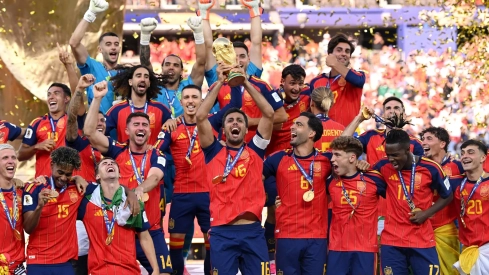
"Few events unite people as much as a World Cup," said Bela Bajaria, Netflix's Chief Content Officer, who recalled the excitement of witnessing Spain's victory in this summer's championship. The executive believes that offering all matches in a host country will allow fans to experience a particularly significant edition.
For his part, Mattias Grafström, FIFA Secretary General, also celebrated the agreement and highlighted the objective of bringing the tournament closer to as many fans as possible.
The company had already taken steps in live sports through agreements related to competitions and events such as the NFL, in addition to wrestling and boxing shows. It also holds the rights to the 2027 and 2031 Women's World Cups in the United States and Canada.
Until now, its presence in Spain had been especially supported by documentaries and sports productions such as LALIGA: Beyond the Goal, Carlos Alcaraz: My Way, and RAFA. The 2030 World Cup represents a qualitative leap: Netflix goes from telling stories about sports to broadcasting live one of the most followed competitions on the planet.
A historic World Cup that changes before it begins
The 2030 edition will celebrate the centenary of the first World Cup, played in Uruguay in 1930. The tournament will have three main host countries —Spain, Portugal, and Morocco— and commemorative matches in Argentina, Paraguay, and Uruguay.
With Spain as one of the venues, the competition will also be an opportunity for television channels and platforms that aspire to capture large audiences. Netflix's entry could modify the traditional distribution of sports rights and open a new stage in the relationship between football and streaming services.
Four years before the start of the championship, several questions remain to be resolved: how much Netflix has paid, which channel will broadcast the matches free-to-air, and what role RTVE will play. What is already confirmed is that the platform will have the rights to all 104 matches for Spain and Andorra, an operation that places the 2030 World Cup at the center of the upcoming battle for the audiovisual business.
Netflix adquiere los derechos audiovisuales exclusivos para España y Andorra de la Copa Mundial de la FIFA 2030™. pic.twitter.com/Gu45LFyu8u
— Netflix España (@NetflixES) October 13, 2026